
2025 was a strong year for equities, with every sector ending the year in positive territory, despite escalating geopolitical tensions. While the energy sector faced challenges in 2025, such as a drop in natural gas prices and declining oil prices, OMV’s share performed outstandingly with a Total Shareholder Return of more than 40%.
Financial Markets
Global equity markets delivered strong returns in 2025, with the MSCI World Index rising 19.7%. European markets also performed well, as the STOXX® Europe 600 gained 16.7%. This resilience was demonstrated despite a challenging backdrop of ongoing geopolitical conflicts, including the war in Ukraine and instability in the Middle East, alongside escalating tariff friction, Venezuelan supply concerns, and deepening global fragmentation.
In 2025, the technology sector was the top performer, buoyed by accelerating investment in artificial intelligence, semiconductors, and cloud infrastructure. This was followed by communication services, aided by robust digital advertising, efficiency gains across platforms, and better‑than‑expected streaming profitability. Industrials benefited from reshoring trends, infrastructure spending, and strong order pipelines across aerospace, transportation, and manufacturing. Utilities also delivered solid returns as shifting interest rate expectations supported yield‑sensitive sectors. Within this environment, energyequities posted a respectable but below‑market performance.
Oil and gas equities diverged somewhat from the underlying commodities in 2025. Crude oil prices weakened notably toward year‑end and pressured upstream results, reflecting oversupply and softening demand. Monthly averages declined from about USD 79/bbl in January to roughly USD 63/bbl in December – the lowest since early 2021 – with added late‑year weakness as OPEC+ signaled higher production targets and global inventories rose. Although geopolitical flare‑ups in the Middle East and infrastructure attacks in the Russia‑Ukraine conflict triggered brief rallies, they did not alter the downward trend.
Despite this, the FTSEurofirst 300 Oil & Gas Index gained more than 18% for the year. While refiners enjoyed healthy margins and midstream operators saw stable throughput volumes, producers were weighed down by the sensitivity of upstream cash flows to falling spot prices. Integrated oil companies rebounded from a difficult prior year, with diversified operations helping offset weaker price realizations, but upstream exposure still led to underperformance relative to downstream‑focused peers.
|
|
2025 |
2024 |
2023 |
2022 |
2021 |
||||||||
|---|---|---|---|---|---|---|---|---|---|---|---|---|---|---|
Number of outstanding shares1 |
in mn |
326.0 |
327.1 |
327.1 |
327.1 |
327.0 |
||||||||
Market capitalization1 |
in EUR bn |
15.6 |
12.2 |
13.0 |
15.7 |
16.3 |
||||||||
Volume traded on the Vienna Stock Exchange |
in EUR bn |
9.5 |
7.7 |
8.0 |
9.8 |
10.4 |
||||||||
Year’s high |
in EUR |
49.48 |
48.08 |
49.23 |
58.26 |
55.00 |
||||||||
Year’s low |
in EUR |
37.74 |
36.34 |
37.57 |
36.02 |
32.74 |
||||||||
Year end |
in EUR |
47.52 |
37.34 |
39.77 |
48.10 |
49.95 |
||||||||
Earnings Per Share (EPS) |
in EUR |
3.11 |
4.25 |
4.53 |
11.12 |
6.40 |
||||||||
Book value per share1 |
in EUR |
50.10 |
54.61 |
55.75 |
58.55 |
47.41 |
||||||||
Cash flow per share2 |
in EUR |
15.95 |
16.69 |
17.46 |
23.73 |
21.47 |
||||||||
Dividend Per Share (DPS)3 |
in EUR |
4.40 |
4.75 |
5.05 |
5.05 |
2.30 |
||||||||
Payout ratio3 |
in % |
141 |
112 |
112 |
45 |
36 |
||||||||
Dividend yield1 |
in % |
9.3 |
12.7 |
12.7 |
10.5 |
4.6 |
||||||||
Total Shareholder Return (TSR)4 |
in % |
41 |
5 |
–7 |
1 |
57 |
||||||||
|
||||||||||||||
OMV Share Performance
The OMV share started the year at EUR 37.74, followed by an upward trajectory. After the announcement of the Borouge Group International transaction on March 3, it reached its first notable high point at EUR 48 on April 1. The impact of uncertainty surrounding US tariffs, following the so-called “Liberation Day” on April 2, was immediately evident, with the share price declining to a support level of EUR 40.68 on April 9. OMV’s share climbed again until the first quarter earnings release on April 30 and then again to reach EUR 48 right before the ex-dividend day on June 4. This was in anticipation of a very competitive total dividend of EUR 4.75 per share, thereof EUR 3.05 per share as the regular dividend and EUR 1.70 per share as the additional dividend, payable in June 2025. OMV’s highest closing price for 2025 came on November 14 at EUR 49.48, two weeks after the third quarter earnings release. Earlier in the year, it had spiked similarly following the second quarter and half-year results. In the remainder of the year, the price faced downward pressure that was mostly in line with the Brent benchmark. The average daily trading volume of OMV shares in 2025 increased 12% to 420,691 shares
OMV share price performance 2025
In EUR
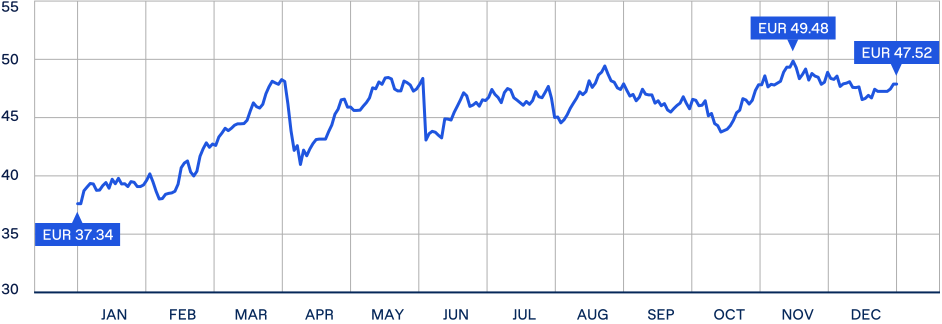
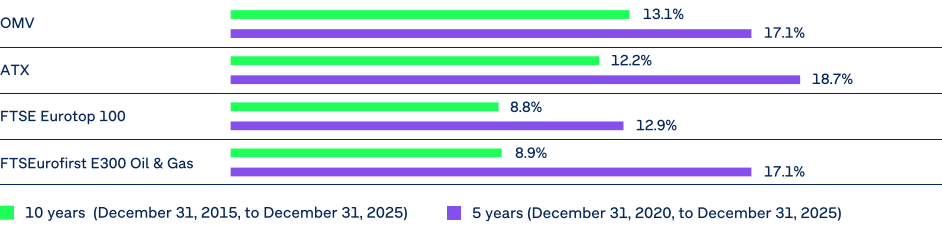
OMV’s share price increased by 27.3% across 2025, thus not as much as the Austrian equity market but still ahead at European level. The Vienna Stock Exchange’s blue chip index ATX was up by 45.4% while the FTSE Eurotop 100 Index was up by 18.6% over the same period. The European oil and gas sector was in line with the overall market (FTSEurofirst 300 Oil & Gas 18.2%), with the Brent crude oil price ending 2025 lower by 15.7% compared to the start of the year. Assuming dividend reinvestment, OMV’s total shareholder return for the year was 41.4%. Measured over a five-year period, the yearly return was lower. A EUR 100 investment in OMV stock at year-end 2020 with continuous dividend reinvestment in further OMV stock would have grown by an average annual return rate of 17.1% to EUR 220 at year-end 2025.
OMV shares: long-term performance compared with indices
Average annual increase with dividends reinvested1
Proposed Regular Dividend of EUR 3.15 and Additional Dividend of EUR 1.25 Per Share for the Business Year 2025
On May 27, 2025, OMV’s Annual General Meeting approved a regular dividend of EUR 3.05 per share, plus an additional dividend of EUR 1.70 per share, adding up to a total per-share dividend amount of EUR 4.75 for 2024. In addition, the Annual General Meeting approved all other agenda items, including the Long-Term Incentive Plan 2025 and the Equity Deferral 2025. Supervisory Board elections were also held.
For the upcoming Annual General Meeting (to be held on May 27, 2026), the Executive Board will propose a regular dividend of EUR 3.15 per share, plus an additional dividend of EUR 1.25 per share for 2025. This represents an annual increase of the regular dividend of more than 3%. Based on the total dividend paid (regular plus additional) of EUR 4.40 per share, the dividend yield calculated using the closing price on the last trading day of 2025 amounts to 9.3%.
Dividend Policy
OMV is committed to delivering an attractive and predictable shareholder return through the business cycle. According to its progressive dividend policy, OMV aims to increase its regular dividend every year or at least to maintain the level of the respective previous year. On top of that, additional variable dividends are awarded provided that the leverage ratio is below 30%.
As before, for the financial year 2025 and the respective dividend to be paid out in June 2026, OMV aims to distribute approximately 20–30% of operating cash flow (including net working capital effects) to its shareholders through its regular dividend, as a priority, and, if the leverage ratio is below 30%, through the additional variable dividend.
For the years following the completion of the Borouge Group International (BGI) transaction, OMV has updated its dividend policy to reflect the changes in accounting and the substantial net floor dividend to OMV of USD 1 bn. Starting with the 2026 financial year, OMV will distribute 50% of BGI dividends attributable to OMV plus 20–30% of cash flow from operating activities excluding BGI dividends. This will impact the distribution in 2027 of the dividends for the 2026 financial year and the years to follow.
OMV Shareholder Structure
OMV’s shareholder structure remained relatively unchanged in 2025 and was as follows at year-end: 43.4% free float, 31.5% Österreichische Beteiligungs AG (ÖBAG, representing the Austrian State), 24.9% ADNOCOMV has been informed by Abu Dhabi National Oil Company (ADNOC) of its intention to transfer its 24.9% shareholding in OMV Aktiengesellschaft to XRG, its wholly owned international investment company. This transfer is subject to regulatory approvals. , 0.4% treasury and LTIP shares.
Shareholder structure
In %

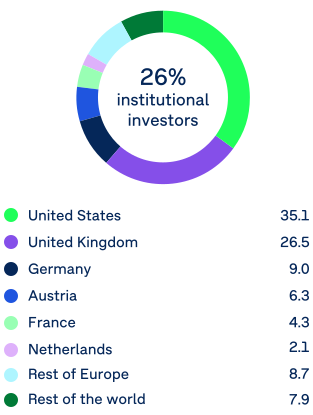
An analysis of our shareholder structure carried out at the end of 2025 showed that institutional investors held 26.0% of OMV’s shares. At 35.1%, investors from the United States made up the largest regional group of institutional investors. The proportion of investors from the United Kingdom amounted to 26.5%, German shareholders made up 9%, and those based in Austria 6.3%. The share of investors from France was 4.3%, and Dutch investors represented 2.1%.
Geographical distribution of institutional investors
In %

OMV Aktiengesellschaft’s capital stock amounts to EUR 327,272,727 and consists of 327,272,727 no par value bearer shares. At year-end 2025, OMV held a total of 1,271,670 treasury shares. The capital stock consists entirely of common shares. Due to OMV’s adherence to the one share, one vote principle, there are no classes of shares that bear special rights. A consortium agreement between the two major shareholders, ÖBAG and ADNOC, contains arrangements for coordinated action and restrictions on the transfer of shareholdings.
Environmental, Social, and Governance (ESG) Performance
OMV continued to rank highly in various ESG ratings in 2025. OMV received a score of AA in the MSCI ESG Ratings assessment, placing the Company among the top seven oil and gas companies globally. OMV also maintained its Prime status in the ISS ESG rating with a score of B–. This ranks us among the top 10% of oil and gas companies in terms of ESG performance. OMV’s Sustainalytics ESG Risk Rating now stands at 30.2 (from 29.6 previously). This puts us in the 12th percentile of the integrated oil and gas sector. OMV was also recognized by CDP with a score of B in the Climate and Water categories.
In addition to these achievements, OMV maintained its inclusion in several ESG indices. Most notably, OMV was included in the Dow Jones Best-in-Class Indices (World and Europe, formerly known as Dow Jones Sustainability Index) for the eighth year in a row. OMV attained a score of 62 in the top 9% of its industry in S&P Global’s Corporate Sustainability Assessment (CSA) in 2025. OMV is part of several MSCI sustainability indices. Furthermore, OMV maintained its position in the FTSE4Good Index Series, which is used by a wide variety of market participants to create and assess responsible investment funds.
Investment-Grade Ratings, Stable Outlook
OMV ratings of A– by Fitch and A3 by Moody’s were reconfirmed, both with a stable outlook, in July 2025. There were no changes to the ratings or outlook during the year.
Analyst Coverage
During 2025, the total number of sell-side analysts covering OMV’s share remained at 22, including restricted analysts due to the announced BGI deal. At the end of the year, 37% of all recommendations were “buy” or equivalent (2024: 50%). Recommendations to “hold” were 53%, up from 45% a year earlier. There were two “sell” recommendations at the end of 2025, representing a share of 11% of all recommendations (2024: 5%). Following the share price development, the average target price for OMV stood at EUR 52 exiting 2025, up from EUR 44 at the end of 2024.
Investor Relations Activities
Ensuring active, candid dialogue with the capital markets is a top priority at OMV. The Investor Relations department’s mission is to provide comprehensive insights into OMV’s strategy and business operations to all capital market participants, thereby guaranteeing the equal treatment of all stakeholders. The main event of 2025 was the presentation of OMV’s Strategy 2030 at the Capital Markets Update held in Vienna on October 6 and 7, where we were able to meet investors and analysts in person. The Executive Board presentations and the Q&A session were also streamed as a live webcast. The following day was used for site visits to the Innovation & Technology Center near Vienna and to close-by Energy facilities such as the Carbon Capture Innovation Center. This was followed by a visit to the integrated Schwechat site, which included the refinery, the newly built ReOil® plant, and Borealis polyolefin plants. In addition to this, the Executive Board and the Investor Relations department strengthened and deepened relationships with analysts and investors across Europe, North America, and Asia. Over the year, OMV was present at more than 24 in-person and virtual investor conferences and more than 20 roadshows, which equalled roughly 300 activities including investor group meetings – up by more than 35% compared with 2024.