
Report on the Consolidated Financial Statements
Audit Opinion
We have audited the consolidated financial statements of
OMV Aktiengesellschaft, Vienna,
and its subsidiaries (“the Group” or “OMV”), which comprise the Consolidated Statement of Financial Position as of December 31, 2025, the Consolidated Income Statement, the Consolidated Statement of Comprehensive Income, the Consolidated Statement of Changes in Equity and the Consolidated Statement of Cash Flows for the year then ended, and the Notes to the Consolidated Financial Statements, except for “Oil and Gas Reserve Estimation and Disclosures (unaudited)”.
In our opinion, the consolidated financial statements comply with the legal requirements and present fairly, in all material respects, the consolidated financial position of the Group as at December 31, 2025, and its consolidated financial performance and consolidated cash flows for the year then ended in accordance with the IFRS Accounting Standards issued by the International Accounting Standards Board (IASB) as adopted by the EU, and the additional requirements pursuant to Section 245a UGB (Austrian Commercial Code).
Basis for our Opinion
We conducted our audit in accordance with the Regulation (EU) No. 537/2014 (“EU Regulation”) and Austrian Standards on Auditing. These standards require the audit to be conducted in accordance with International Standards on Auditing (ISAs). Our responsibilities under those standards are further described in the “Auditor’s Responsibilities for the Audit of the Consolidated Financial Statements” section of our report. We are independent of the audited Group in accordance with Austrian company law and professional regulations, and we have fulfilled our other responsibilities under those relevant ethical requirements. We believe that the audit evidence we have obtained up to the date of the auditor’s report is sufficient and appropriate to provide a basis for our audit opinion on this date.
Our liability as auditors is guided under Section 275 UGB (Austrian Commercial Code).
Key Audit Matters
Key audit matters are those matters that, in our professional judgment, were of most significance in our audit of the consolidated financial statements. These matters were addressed in the context of our audit of the consolidated financial statements as a whole, however, we do not provide a separate opinion thereon.
Climate change and the energy transition has a significant impact on OMV’s business and represents a strategic challenge. It is correspondingly a matter with overarching importance for the consolidated financial statements and potentially has an impact on a number of individual line items of the consolidated financial statements and on disclosures included in the notes to the consolidated financial statements. These effects had a significant impact on our overall audit strategy. As a result, we have identified the following key audit matters that are related to climate change and the energy transition:
Disclosures on the effects of climate change and the energy transition;
Recoverability of oil and gas assets with proved reserves;
Recoverability of equity-accounted investments;
Valuation of provisions for decommissioning and restoration obligations; and
Recoverability of refining assets.
These individual key audit matters are described in detail below in addition to other key audit matters.
Disclosures on the effects of climate change and the energy transition
Refer to Note 3 – Effects of Climate Change and the Energy Transition.
Risk for the Consolidated Financial Statements
As part of its strategy 2030 presented in 2022, the Group is fully committed to supporting the energy transition. The Group aims to become a net-zero emissions company by 2050.
In Note 3 of the consolidated financial statements the Group describes how management considers both climate-related impacts and emission reduction targets in key areas of the consolidated financial statements and how this impacts the valuation of assets and measurement of liabilities.
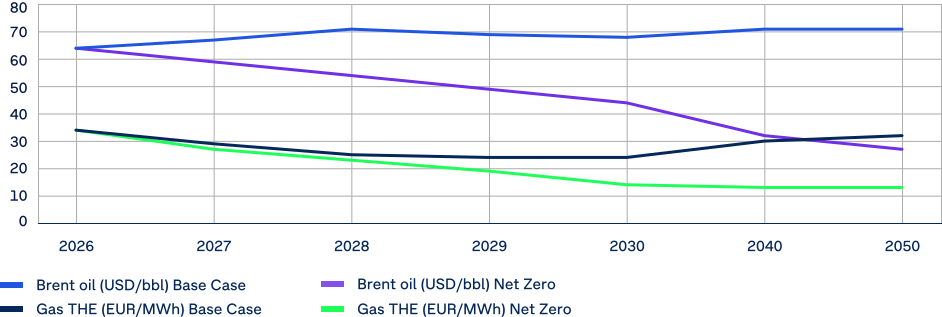
OMV considers two different scenarios:
the base case, whose assumptions in terms of demand and oil and gas prices are consistent with IEA Stated Policies Scenario (STEPS), is used for the mid-term planning as well as for estimates for various areas of the consolidated financial statements, including impairment testing of non-financial assets and the measurement of provisions; and
the “net zero emissions by 2050” case, whose assumptions are consistent with the IEA Net Zero Emissions (NZE) scenario, is used to perform a sensitivity analysis for the valuation of non-financial assets and the measurement of provisions.
These scenarios differ in the underlying expectations about the pace of the future worldwide decarbonization and lead to different assumptions for demand and prices of oil and gas as well as CO2 prices.
2025 price assumptions
The main areas impacted by the effects of climate change and the energy transition are:
the recoverability of assets;
the useful lives of assets; and
the valuation of provisions for decommissioning and restoration obligations.
Because of the high level of uncertainty and the complexity of the transformation in a “net zero emissions by 2050” scenario for refinery assets in the Fuels segment and assets in the Chemicals segment, the disclosure is focused on sensitivities and qualitative analysis.
The disclosures on the above areas have high public attention and involve a high degree of judgment and significant macroeconomic assumptions. Therefore, we have identified the disclosures on the effects of climate change and the energy transition as a key audit matter.
Our response
We evaluated the disclosures on the effects of climate change and the energy transition as follows:
We evaluated the design and implementation of internal controls in the estimation process, with a focus on how the effects of climate change and the energy transition were considered for the key assumptions in the impacted areas of the consolidated financial statements.
We implemented a climate change panel comprising a group of experienced international KPMG Partners with specific climate change, energy transition, technical audit or accounting expertise to provide an independent challenge to our key decisions and conclusions with respect to the key assumptions to this key audit matter.
We performed inquiries to understand the impacts of climate change and the energy transition on the consolidated financial statements.
We compared the assumptions for oil and gas as well as CO2 prices used in the base case and the “net zero emissions by 2050” case with publicly available information (the IEA STEPS and NZE scenarios).
We evaluated whether the impacts of climate change and the energy transition were reflected in the respective disclosures for the recoverability of assets, the useful lives of assets, and the valuation of provisions for decommissioning and restoration obligations.
We read the consolidated sustainability statement and assessed whether there are inconsistencies with the consolidated financial statements.
We evaluated the accuracy of these disclosures in the consolidated financial statements.
Recoverability of oil and gas assets with proved reserves
Refer to Note 3 – Effects of Climate Change and the Energy Transition, Note 9 – Depreciation, Amortization, Impairments and Write-ups and Note 17 – Property, Plant, and Equipment.
Risk for the Consolidated Financial Statements
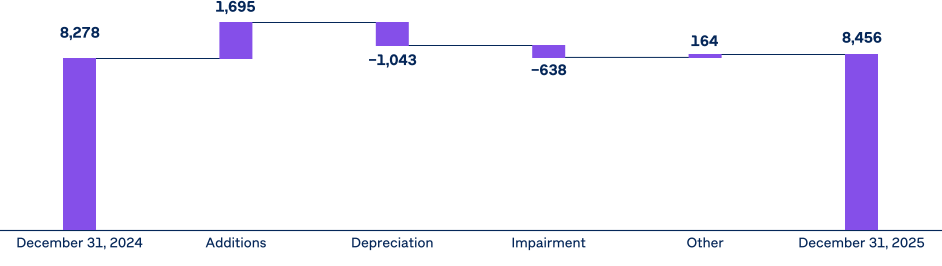
The carrying value of oil and gas assets with proved reserves amounts to EUR 8,456 mn as of December 31, 2025.
The assets’ operational performance and external factors have a significant impact on the estimated future cash flows and, therefore, the recoverable amount of the oil and gas assets with proved reserves. The recoverable amount is highly judgmental and complex to estimate. The key assumptions considered by the Group in assessing the value in use include oil and gas prices, CO2 prices, oil and gas reserves, and discount rates. As described in Note 3 these significant assumptions are forward-looking and can be affected by future economic and market conditions, including matters related to climate change and the energy transition.
The Group recorded impairments of EUR 638 mn on oil and gas assets with proved reserves as of December 31, 2025.
Oil and gas assets with proved reserves
(in EUR mn)
There is a risk for the consolidated financial statements that the valuation of oil and gas assets with proved reserves is inadequate and the related impairment loss is misstated.
Our response
We assessed the recoverability of oil and gas assets with proved reserves as follows:
We obtained an understanding and evaluated the design and implementation of key internal controls over the process for evaluating the recoverable amount of oil and gas assets with proved reserves. Our work included testing control activities over the identification of triggering events and the determination of key management assumptions underlying the recoverable amount of the assets tested.
Future cash flows
We compared the main assumptions (future oil and gas prices, future CO2 prices, production volumes, future production costs) used within the future cash flow models to those included in mid-term planning approved by the Supervisory Board.
We assessed the consistency of the assumptions on future production costs by analyzing cost-to-production ratios and comparing them year over year.
Price assumptions
We assessed the reasonableness of future short and long-term oil and gas price assumptions by comparing these to available industry information, especially IEA’s STEPS scenario.
We examined the CO2 price assumptions included in the future cash flows by comparing them with current market data and available industry information.
Oil and gas reserves
We obtained an understanding of the Group’s Petroleum Resource Evaluation Standard and performed a walkthrough of the reserve estimation process and controls.
We compared production forecasts to the internal evaluations of proved and probable oil and gas reserves. We also inquired with internal reservoir engineers and reviewed supporting documentation to understand the status of production forecasts not classified as reserves.
We reviewed for selected assets prior period reserves estimates made by the independent expert DeGolyer & MacNaughton and inquired about differences to internal estimations.
We assessed the competence and objectivity of internal reservoir engineers responsible for estimating oil and gas reserves, as well as the independent expert DeGolyer & MacNaughton, through understanding their relevant professional qualifications and experience.
We inquired about the reasons for significant changes in oil and gas reserves for certain assets.
Discount rates
With the assistance of our valuation specialists, we assessed input assumptions for determining discount rates by comparing them with market and industry-specific benchmarks.
Other procedures
We assessed the determination of cash generating units based on industry practice and how cash flows are generated.
We assessed management’s identification of indicators for impairments and write-ups.
We verified the mathematical accuracy of relevant discounted cash flow models.
We assessed the adequacy of the disclosures in the consolidated financial statements.
Recoverability of equity-accounted investments
Refer to Note 18 – Equity-Accounted Investments.
Risk for the Consolidated Financial Statements
The carrying value of equity-accounted investments amounts to EUR 5,255 mn as of December 31, 2025, including mainly Borouge PLC (part of Borouge Investments) and Abu Dhabi Oil Refining Company (ADNOC Refining).
Equity-accounted investments as of December 31, 2025
(in EUR mn)

Borouge PLC is listed on the Abu Dhabi stock exchange. As the pro rata market capitalization significantly exceeds the carrying value of the investment and the investment regularly makes high dividend distributions from current earnings, we do not assume a valuation risk for this investment.
For ADNOC Refining, the assessment of the recoverable amount requires judgment and estimates in the following areas:
determining whether there is an indication that the investment should be impaired, or there is an indication that an impairment loss recognized in prior periods may no longer exist or may have decreased; and
measuring any such impairment loss or impairment reversal.
The key assumptions considered by the Group in assessing the recoverable amount of ADNOC Refining include margin forecasts, future utilization rates or production volumes, discount rates as well as perpetual growth rates. Given the complexity of the impairment model, the estimation uncertainty over input data and parameters used and the immanent judgment, the recoverability of the equity-accounted investments ADNOC Refining is considered a key audit matter.
Overall, there is a risk for the consolidated financial statements that the valuation of equity-accounted investments is misstated.
Our response
We assessed the recoverability of the equity-accounted investment ADNOC Refining as follows:
We obtained an understanding over the process regarding the identification of indicators for impairment and the determination of key assumptions underlying the recoverable amount of the equity-accounted investment.
We compared the main assumptions for future utilization rates or production volumes used within the future cash flow models to those included in available budgets.
We analyzed margin forecasts with external market data and other publicly available information.
We challenged the assumptions in the discounted cash flow model by performing a sensitivity analysis, considering a range of likely outcomes based on various scenarios.
With the assistance of our valuation specialists, we assessed a range of reasonable input assumptions for determining discount rates and perpetual growth rates.
We verified the mathematical accuracy of the valuation models.
We assessed the adequacy of the disclosures in the consolidated financial statements.
Valuation of provisions for decommissioning and restoration obligations
Refer to Note 25 – Decommissioning and Other Provisions.
Risk for the Consolidated Financial Statements
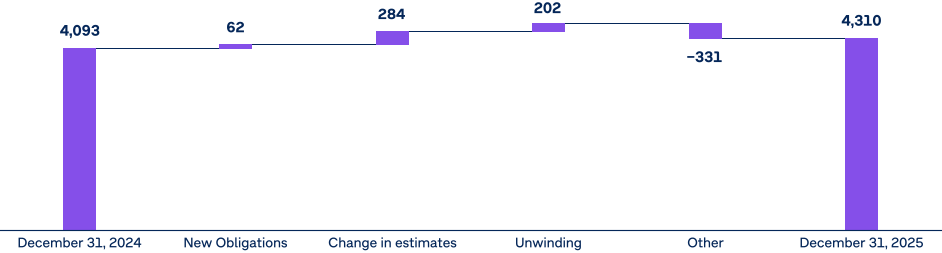
Provisions for decommissioning and restoration obligations of EUR 4,310 mn are recorded in the consolidated financial statements as of December 31, 2025.
Provisions for decommissioning and restoration obligations
(in EUR mn)
As described in Note 25, the Group’s core activities regularly lead to obligations related to dismantling and removal, asset retirement, and soil remediation activities. Most of these activities are planned to occur many years in the future and may also be affected by climate change and the energy transition, while decommissioning technologies, costs, and regulations are constantly changing.
The estimation of provisions for decommissioning and restoration obligations is thus a judgmental area as it involves a number of key estimates related to future costs and timing of decommissioning, inflation, and discount rate assumptions.
There is a risk for the consolidated financial statements that the valuation of provisions for decommissioning and restoration obligations is misstated.
Our response
We assessed the valuation of provisions for decommissioning and restoration obligations as follows:
We obtained an understanding, evaluated the design and implementation, and tested the operating effectiveness of key internal controls over the Group’s process to calculate the present value of the estimated future costs for decommissioning and restoration obligations in accordance with local regulation and requirements.
We assessed the completeness of the assets subject to decommissioning and restoration obligations, especially by understanding the process to determine whether a legal or constructive obligation exists at the reporting date and by comparing the significant additions to property, plant, and equipment to the Group’s assessment of new decommissioning and restoration obligations.
We inquired about changes in the regulatory and legal environment in the respective countries and evaluated whether any changes had an impact on the decommissioning and restoration obligations.
Future costs and timing of decommissioning
We confirmed that the estimated dates used for decommissioning are consistent with assumptions in other areas, especially impairment testing on oil and gas assets and estimation of oil and gas reserves.
We verified the supporting evidence for any material revision in cost estimates during the period.
We compared cost estimates to actual decommissioning costs incurred during the period.
Discount and inflation rates
With the support of our valuation specialists, we analyzed inflation rates and discount rates by comparing them with market and industry-specific benchmarks.
Other procedures
We tested the mathematical accuracy of the decommissioning and restoration obligation calculation.
We assessed the adequacy of the disclosures in the consolidated financial statements.
Recoverability of refining assets
Refer to Note 3 – Effects of Climate Change and the Energy Transition, Note 9 – Depreciation, Amortization, Impairments and Write-ups and Note 17 – Property, Plant, and Equipment.
Risk for the Consolidated Financial Statements
Refining assets are recorded in the consolidated financial statements as of December 31, 2025 with an amount of EUR 3,758 mn.
Due to changes in supply and demand which arise as a consequence of macroeconomic fluctuations in addition to the impacts from climate change and the energy transition, economic benefits from refining assets fluctuate over time. In addition, there are uncertainties which require judgment and estimates in the following areas:
the level of investments into refining assets to shift their output towards the production of sustainable chemical feedstock and renewable fuels;
future cash flows from the sale of output from the refining assets;
economic useful lives of refining assets which depend on the speed of society’s move towards net zero emissions.
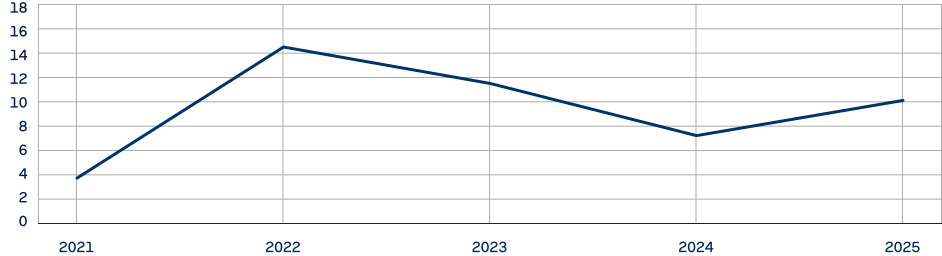
OMV Refining indicator margin Europe
(in USD/bbl)
There is a risk for the consolidated financial statements that the valuation of refining assets is inadequate, and the related impairment loss is misstated.
Our response
We assessed the recoverability of refining assets as follows:
We obtained an understanding and evaluated the design and implementation of key internal controls over the process for evaluating the recoverable amount of refining assets. Our work included testing control activities over the identification of triggering events and the determination of key management assumptions underlying the recoverable amount of the assets tested.
We obtained an overall understanding of OMV’s strategy for their refining assets.
We reviewed internal and external market studies of future supply and demand to evaluate the impact of potential changes in supply and demand on the group’s refining portfolio.
For refining assets included in cash-generating units without goodwill, we assessed management’s analysis of indicators for impairment.
We assessed the reasonableness of assumptions (future utilization rates, future refining margins) used within the future cash flow models by comparing them with available industry information.
We compared the main assumptions used within the future cash flow models to those included in mid-term planning approved by the Supervisory Board.
With the assistance of our valuation specialists, we assessed input assumptions for determining discount rates by comparing them with market and industry-specific benchmarks.
We evaluated management’s ability to forecast future cash flows and margins by comparing actual results to historical forecasts.
We assessed the mathematical accuracy of the discounted cash flow models.
We assessed economic useful lives by comparing them to industry peers.
We evaluated the appropriateness of the remaining economic useful lives by considering the forecasts for demand for refined petroleum products under the IEA Stated Policies Scenario.
We assessed the adequacy of the disclosures in the consolidated financial statements.
Accounting for and presentation of Borealis disposal group as held for sale and discontinued operation
Refer to Note 4 – OMV and ADNOC to Establish a New Polyolefins Joint Venture and Note 5 – Assets and Liabilities Held for Sale.
Risk for the Consolidated Financial Statements
The assets of Borealis disposal group (Borealis group excluding the Borouge investments) and the associated liabilities are presented in the consolidated statement of financial position separately from the Group’s other assets and liabilities as of December 31, 2025, without restatement of the balance sheet as of December 31, 2024, for a carrying amount of EUR 10,594 mn and EUR 3,510 mn, respectively.
On March 3, 2025, OMV and ADNOC signed a binding agreement for the combination of their shareholdings in Borealis and Borouge into the new company Borouge Group International. The framework agreement sets out that OMV and ADNOC will have equal shareholdings and equal partnership in Borouge Group International following a cash injection of EUR 1.6 bn (reduced by dividends paid out until closing) by OMV into that new company. Based on the signed agreement, OMV is expected to lose control over Borealis disposal group (excluding the Borouge investments) upon closing of the transaction which is expected in Q1 2026 subject to regulatory approvals and other customary conditions.
Therefore, in accordance with IFRS 5, Borealis disposal group (excluding the Borouge investments) has been classified as held for sale since March 3, 2025, and reported as discontinued operations since it represents a separate major line of business of OMV in the Chemicals segment. The net income from discontinued operations attributable to Borealis disposal group amounted to EUR 307 mn for the year ended December 31, 2025.
In EUR mn |
|
|
|
2025 |
2024 |
|---|---|---|
Assets held for sale (Borealis disposal group) |
10,594 |
– |
Liabilities associated with assets held for sale (Borealis disposal group) |
3,510 |
– |
In EUR mn |
|
|
|
2025 |
2024 |
|---|---|---|
Net income from discontinued operations |
307 |
88 |
The Borouge investments are still accounted for according to the equity method and are not part of Borealis disposal group because they will continue to be jointly controlled by OMV and ADNOC as part of Borouge Group International after the completion of the transaction.
We have identified the accounting for and the presentation of Borealis disposal group as held for sale and discontinued operation as a key audit matter, considering:
The size of the transaction, as Borealis disposal group represents a separate major line of business.
The complexity in applying IFRS 5 induced by the pre-existing cross-shareholdings of OMV and ADNOC in Borealis and Borouge.
The significant impact on the presentation of the consolidated financial statements and their notes.
There is a risk for the consolidated financial statements that the accounting for and the presentation of Borealis disposal group as held for sale and discontinued operation is inadequate.
Our response
We assessed the accounting for and presentation of Borealis disposal group as held for sale and discontinued operation as follows:
We confirmed the appropriateness of the classification of Borealis disposal group as held for sale and discontinued operation in accordance with IFRS 5, especially through the review of the minutes of the meetings of the Executive Board and the Supervisory Board related to the contemplated transaction and the analysis of the binding agreement signed on March 3, 2025 between OMV and ADNOC.
We verified the correct identification and valuation of assets and liabilities recorded as held for sale in the balance sheet as of December 31, 2025, as well as the presentation of net income attributable to Borealis disposal group as net income from discontinued operations in the consolidated income statement for the financial years 2025 and 2024.
We assessed that Borealis disposal group was measured at the lower of its carrying amount and fair value less costs to sell in accordance with IFRS 5 principles.
We verified the restatement of comparative information on the basis of the classification of the Borealis disposal group as discontinued operations.
We assessed the accounting treatment and presentation retained on transactions existing between OMV’s continuing operations and the Borealis disposal group.
We analyzed the reassessment of the net deferred tax asset position of the Austrian tax group triggered by the expected partial disposal of Borealis group from the Austrian tax group.
We assessed the adequacy of the disclosures in the consolidated financial statements.
Recoverability of receivable from the Romanian State related to obligations for decommissioning and environmental costs
Refer to Note 11 – Other Operating Expenses and Note 20 – Financial Assets.
Risk for the Consolidated Financial Statements
The carrying value of the receivable from the Romanian State related to obligations for decommissioning and environmental costs in OMV Petrom S.A. amounts to EUR 223 mn as of December 31, 2025, after an impairment in the amount of EUR 297 mn in 2025.
As part of the privatization agreement between the Romanian State and OMV Aktiengesellschaft, the Group is entitled to a reimbursement by the Romanian State of part of decommissioning and environmental costs incurred relating to activities prior to privatization in 2004. Consequently, the Group has recognized as receivable from the Romanian State the corresponding estimated decommissioning and environmental remediation costs subject to the privatization agreement. In accordance with relevant accounting standards, such a reimbursement asset is recognised only when recovery is virtually certain.
In December 2025, following an agreed set of legal and contractual objectives between OMV Petrom S.A. and the Romanian State, which include, among others, the 15 years extension of production licenses, an impairment of EUR 297 mn was recorded in “Other operating expenses”, related to the receivable from Romanian State for decommissioning obligations foreseen to be incurred by OMV Petrom S.A. at its own costs. The finalization of this set of legal and contractual objectives is expected in 2026. Consequently, as of December 31, 2025, the portion of the receivable from Romanian State for which recoverability is not probable has been impaired, while the balance assessed as virtually certain continues to be recognised.
We considered this matter a key audit matter due to the size of the impairment and the complexity of evaluating its appropriate accounting treatment.
There is a risk for the consolidated financial statements that the valuation of the receivable from the Romanian State related to obligations for decommissioning and environmental costs is misstated.
Our response
We assessed the recoverability of receivable from the Romanian State related to obligations for decommissioning and environmental costs in OMV Petrom S.A. as follows:
We obtained an understanding of the set of legal and contractual objectives that were agreed with the Romanian State in December 2025 and verified that the impairment of EUR 297 mn recorded on the receivable from the Romanian State was consistent with the terms of those legal and contractual objectives.
We inspected key documentation supporting management’s conclusion that the balance remaining recognised is virtually certain as of December 31, 2025 (including evidence of the agreed settlement principles and payment profile, where applicable).
We assessed the adequacy of the disclosures in the consolidated financial statements.
Other Information
Management is responsible for other information. Other information is all information provided in the annual report, other than the consolidated financial statements, the group management report and the auditor’s report.
Our opinion on the consolidated financial statements does not cover other information and we do not provide any kind of assurance thereon.
In conjunction with our audit, it is our responsibility to read this other information and to assess whether, based on our knowledge gained during our audit, it contains any material inconsistencies with the consolidated financial statements or any apparent material misstatement of fact.
If, on the basis of our work on the other information obtained, we conclude that there is a material misstatement of fact in other information, we must report that fact. We have nothing to report in this regard.
Responsibilities of Management and the Audit Committee for the Consolidated Financial Statements
Management is responsible for the preparation and fair presentation of the consolidated financial statements in accordance with the IFRS Accounting Standards as adopted by the EU and the additional requirements pursuant to Section 245a UGB (Austrian Commercial Code) and for such internal controls as management determines are necessary to enable the preparation of consolidated financial statements that are free from material misstatement, whether due to fraud or error.
Management is also responsible for assessing the Group’s ability to continue as a going concern, disclosing, as applicable, matters related to going concern and using the going concern basis of accounting, unless management either intends to liquidate the Group or to cease operations, or has no realistic alternative but to do so.
The audit committee is responsible for overseeing the Group’s financial reporting process.
Auditor’s Responsibilities for the Audit of the Consolidated Financial Statements
Our objectives are to obtain reasonable assurance about whether the consolidated financial statements taken as a whole, are free from material misstatements, whether due to fraud or error, and to issue an auditor’s report that includes our audit opinion. Reasonable assurance represents a high level of assurance but provides no guarantee that an audit conducted in accordance with the EU Regulation and with Austrian Standards on Auditing (and therefore ISAs), will always detect a material misstatement, if any. Misstatements may result from fraud or error and are considered material if, individually or in aggregate, they could reasonably be expected to influence the economic decisions of users based on the consolidated financial statements.
As part of an audit in accordance with the EU Regulation and with Austrian Standards on Auditing, we exercise professional judgment and maintain professional skepticism throughout the audit.
Moreover:
We identify and assess the risks of material misstatement in the consolidated financial statements, whether due to fraud or error, we design and perform audit procedures responsive to those risks and obtain sufficient and appropriate audit evidence to serve as a basis for our audit opinion. The risk of not detecting material misstatements resulting from fraud is higher than for one resulting from error, as fraud may involve collusion, forgery, intentional omissions, misleading representation or override of internal control.
We obtain an understanding of internal control relevant to the audit in order to design audit procedures that are appropriate in the circumstances, but not for the purpose of expressing an opinion on the effectiveness of the Group’s internal control.
We evaluate the appropriateness of accounting policies used and the reasonableness of accounting estimates and related disclosures made by management.
We conclude on the appropriateness of management’s use of the going concern basis of accounting and, based on the audit evidence obtained, whether a material uncertainty exists related to events or conditions that may cast significant doubt on the Group’s ability to continue as a going concern. If we conclude that a material uncertainty exists, we are required to draw attention in our auditor’s report to the respective note in the consolidated financial statements. If such disclosures are not appropriate, we will modify our audit opinion. Our conclusions are based on the audit evidence obtained up to the date of our auditor’s report. However, future events or conditions may cause the Group to cease to continue as a going concern.
We evaluate the overall presentation, structure and content of the consolidated financial statements, including the notes, as well as whether the consolidated financial statements represent the underlying business transactions and events in a manner that achieves fair presentation.
We plan and conduct the audit of the consolidated financial statements in order to obtain sufficient appropriate audit evidence on the financial information of the components within the Group, in order to form an audit opinion. We are responsible for directing, supervising and reviewing the audit activities carried out for the purposes of auditing the consolidated financial statements. We remain solely responsible for our audit opinion.
We communicate with the audit committee regarding, amongst other matters, the planned scope and timing of our audit as well as significant findings, including any significant deficiencies in internal control that we identify during our audit.
We communicate to the audit committee that we have complied with the relevant professional requirements in respect of our independence, that we will report any relationships and other events that could reasonably affect our independence and, where appropriate, the related safeguards.
From the matters communicated with the audit committee, we determine those matters that were of most significance in the audit i.e. key audit matters. We describe these key audit matters in our auditor’s report unless laws or other legal regulations preclude public disclosure about the matter or when, in rare cases, we determine that a matter should not be included in our auditor’s report because the negative consequences of doing so would reasonably be expected to outweigh the public benefits of such communication.
Report on Other Legal and Regulatory Requirements
Group Management Report
In accordance with Austrian company law, the group management report is to be audited as to whether it is consistent with the consolidated financial statements and prepared in accordance with the applicable legal requirements. It is our responsibility to determine whether the consolidated non-financial statement has been prepared as part of the group management report, to read it and to assess whether, based on knowledge gained during our audit, it contains any material inconsistencies with the consolidated financial statements or otherwise appears to be materially misstated.
Management is responsible for the preparation of the group management report in accordance with Austrian company law.
We have conducted our audit in accordance with generally accepted standards on the audit of group management reports.
Opinion
In our opinion, the group management report is consistent with the consolidated financial statements and has been prepared in accordance with legal requirements. The disclosures pursuant to Section 243a UGB (Austrian Commercial Code) are appropriate.
Statement
Based on our knowledge gained in the course of the audit of the consolidated financial statements and our understanding of the Group and its environment, we did not note any material misstatements in the group management report.
Additional information in accordance with Article 10 EU Regulation
We were elected as auditors at the Annual General Meeting on May 27, 2025 and were appointed by the supervisory board on August 21, 2025 to audit the consolidated financial statements of the Company for the financial year ending on December 31, 2025.
We have been auditors of the Company, without interruption, since the consolidated financial statements as of December 31, 2023.
We declare that our opinion expressed in the “Report on the Consolidated Financial Statements” section of our report is consistent with our additional report to the Audit Committee, in accordance with Article 11 EU Regulation.
We declare that we have not provided any prohibited non-audit services (Article 5 Paragraph 1 EU Regulation) and that we have ensured our independence throughout the course of the audit.
Engagement Partner
The engagement partner is Mr Karl Braun.
Vienna
March 16, 2026
KPMG Austria GmbH
Wirtschaftsprüfungs- und Steuerberatungsgesellschaft
Karl Braun m.p.
Wirtschaftsprüfer
(Austrian Chartered Accountant)
This report is a translation of the original report in German, which is solely valid.
The consolidated financial statements together with our auditor’s opinion may only be published if the consolidated financial statements and the group management report are identical with the audited version attached to this report. Section 281 Paragraph 2 UGB (Austrian Commercial Code) applies.