
Overall Composition of Administrative, Management, and Supervisory Bodies
OMV has a two-tier governance structure consisting of an Executive Board and a Supervisory Board. The Executive Board, composed of the CEO (who has also been appointed as Chairman of the Executive Board), CFO, Executive Vice President (EVP) Energy, EVP Fuels, and EVP Chemicals, is the highest managing body of the Company and is responsible for setting and implementing the Company strategy, including climate and other sustainability targets.
OMV’s Supervisory Board generally consists of ten members elected by the general meeting of shareholders (shareholder representatives) and five members delegated by the employee representation body (employee representatives). Following a resignation in June 2024, the Supervisory Board temporarily consisted of only nine shareholder representatives until the Annual General Meeting 2025, which was held on May 27, 2025. One of the Supervisory Board members serves as Chairperson after being elected by the Supervisory Board.
The management of the Company is vested with the Executive Board. Members are appointed by the Supervisory Board for a period of up to five years; re-appointments are possible. Currently, the Executive Board comprises four members whose tenure runs as follows:
-
Alfred Stern (CEO), contractual term of office: September 1, 2021–August 31, 2026
-
Reinhard Florey (CFO), contractual term of office: July 1, 2016–June 30, 2027
-
Martijn Arjen van Koten (Executive Vice President Fuels and, following Daniela Vlad’s resignation from the Executive Board, also ad-interim Executive Vice President Chemicals effective March 1, 2025), contractual term of office: July 1, 2021–June 30, 2031
-
Berislav Gaso (Executive Vice President Energy), contractual term of office: March 1, 2023–February 29, 2028
Daniela Vlad was a member of the Executive Board as Executive Vice President Chemicals until February 28, 2025, which is the effective date of her resignation from the Executive Board.
The Executive Board is monitored, supervised, and advised by the Supervisory Board on relevant matters, including strategy development. Certain decisions made by the Executive Board are subject to approval by the Supervisory Board. The Supervisory Board also assesses the performance of the Executive Board, including on sustainability criteria. The Executive Board reports to the Supervisory Board on a regular and ad hoc basis.
Experience and Expertise
The administrative, management, and supervisory bodies at OMV have a broad range of sector-relevant experience and international expertise:
Executive Board
Members who served on the Executive Board during 2025 are of three different nationalities, showcasing extensive international management experience in all relevant business segments:
Alfred Stern has been Chairman of the Executive Board and CEO of OMV Aktiengesellschaft since September 2021, after joining the Company as board member for Chemicals in April 2021. Previously, he was CEO of Borealis and held various executive roles there over 14 years, following an international career that began at DuPont de Nemours.
Reinhard Florey has been the CFO of OMV Aktiengesellschaft since July 1, 2016. He started his career in corporate consulting and strategy consulting. From 2002 to 2012 he worked in a number of positions worldwide for thyssenkrupp Steel. His most recent post prior to joining OMV was as CFO and deputy CEO of Outokumpu.
Martijn Arjen van Koten has been a member of the Executive Board of OMV Aktiengesellschaft since July 1, 2021, responsible for the Fuels division and, following Daniela Vlad’s resignation from the Executive Board, also ad-interim Executive Vice President Chemicals effective March 1, 2025. He previously held various management roles at Shell and Borealis, gaining extensive international experience in refining, manufacturing, and operations across Europe, Asia, and the United States.
Berislav Gaso assumed his role as member of the Executive Board of OMV Aktiengesellschaft, where he is responsible for the Energy division, on March 1, 2023. He held various management positions in the MOL Group after working as a junior partner at McKinsey & Company. Most recently, he served as the Executive Vice President in charge of the MOL Group’s Exploration & Production division.
Daniela Vlad was a member of the Executive Board of OMV Aktiengesellschaft from February 1, 2023, until February 28, 2025, serving as Executive Vice President Chemicals. She had previously held management roles at Shell, Philips, and AkzoNobel, and brought extensive international experience in the chemical industry, strategic transformation, and sustainable technical solutions.
More details about the members’ experience can be found on our website The OMV Executive Board | OMV.com
Supervisory Board
The members of the Supervisory Board elected by the shareholders in a general meeting (shareholders’ representatives) have significant experience in leading roles across various sectors:
Lutz Feldmann is an independent business consultant and chairman of the supervisory boards of EnBW Energie Baden-Württemberg AG and Thyssen’sche Handelsgesellschaft mbH. During the course of his over 40-year career, he has held various executive and management positions at Aral AG, BP AG (Germany), and E.ON AG (marketing, retail, and corporate management).
Edith Hlawati was appointed CEO of Österreichische Beteiligungs AG (ÖBAG) in 2022, a holding company managing the Republic of Austria’s shares in various companies. Before joining ÖBAG, she was a registered attorney and senior partner at a leading Austrian corporate law firm, and she currently holds supervisory board positions at VERBUND AG, Telekom Austria AG, and EuroTeleSites AG.
Khaled Salmeen was Chief Executive Officer Downstream Industry, Marketing and Trading, at the Abu Dhabi National Oil Company (ADNOC) until 2025 and holds board seats in several ADNOC Group companies. He previously held leadership roles at Borouge, Abu Dhabi Future Energy Company, Tabreed, and Khalifa Industrial Zone Abu Dhabi, as well as serving as Executive Director of Marketing, Supply, and Trading at ADNOC.
Khaled Al Zaabi is CFO of the Abu Dhabi National Oil Company Group. Prior to becoming the Group CFO, he was the Senior Vice President for financial planning, budgeting, and reporting. He serves as a board member in various listed and non-listed companies of the ADNOC Group.
Dorothée Deuring is the CEO of Deuring Corporate Advisory and has a background in chemistry, strategy consulting, and investment management, with previous roles at McKinsey & Company, CoCap AG, F. Hoffmann La Roche AG, Bankhaus Sal. Oppenheim, and UBS AG. She has held numerous board positions and currently serves as a board member Cornucopia SIVAC SIF.
Patrick Lammers is the CEO of Skyborn Renewables GmbH and previously held senior roles at Royal Dutch Shell, Dyson Group plc, AEA Investors, Essent N.V., and innogy SE. He was also a member of the board of management at E.ON SE until May 2024.
Hans Joachim Müller was elected as a member of the Supervisory Board of OMV Aktiengesellschaft by the Annual General Meeting 2025 and previously served as CEO of Azelis SA from 2012 to 2023. Before that he held senior executive roles at Clariant AG, Süd-Chemie AG, and BASF AG. Hans Joachim Müller is currently a non-executive director at LANXESS AG and AkzoNobel N.V. as well as chairman of the supervisory board of TIB Chemicals AG.
Jean-Baptiste Renard is an independent business consultant and founding partner of 2PR Consulting, who worked for BP plc for over 20 years in various roles including supply manager for Europe and regional group vice president for Europe and Southern Africa. He currently holds several non-executive board positions, including at the Exolum Group, and was a non-executive director at Neste until 2022.
Elisabeth Stadler holds supervisory board positions at voestalpine AG, Österreichische Post AG (as chairwoman), and Andritz AG (as deputy chairwoman). She has had a long career in the insurance industry, serving as CEO of Ergo Versicherungsgruppe AG, Donau Versicherung AG, and most recently VIG Vienna Insurance Group AG until June 2023.
Robert Stajic was Executive Director of Österreichische Beteiligungs AG (ÖBAG) until September 30, 2025, and is a supervisory board member at VERBUND AG, with previous experience as Engagement Manager at McKinsey & Company. He has held various roles at OMV Aktiengesellschaft, including in transformation and procurement, and later served as director of corporate development and transformation at Semperit AG.
These individuals bring broad expertise in executive positions, business consultancy, and leadership roles in major companies, which is relevant to OMV’s sectors and products. Their extended profiles with more details are publicly available on our website under The OMV Supervisory Board | OMV.com
Employee Representation
The Supervisory Board incorporates employee representation through the employee representation body. Austrian law requires that for every two shareholder representatives, the employee representation body nominates one employee representative to serve on the Supervisory Board. If the number of shareholder representatives is uneven, an additional employee representative can be nominated by the employee representation body. Therefore, there are currently five employee representatives on the Supervisory Board, ensuring that the workforce’s interests and perspectives are represented in decision-making processes.
Employee representatives |
Position in Supervisory Board |
Position in Works Council |
Term of office |
||
|---|---|---|---|---|---|
Angela Schorna |
Member |
Chairwoman of the Employee Works Council of OMV Aktiengesellschaft |
First appointed in 2018 |
||
Alexander Auer |
Member |
Chairman of the Company Works Council of OMV Downstream GmbH |
First appointed in 2021 |
||
Nicole Schachenhofer |
Member |
Chairwoman of the Employee Works Council of OMV Austria Exploration & Production GmbH |
First appointed in 2021 |
||
Hubert Bunderla1 |
Member |
Deputy Chairman of the Group Works Council of OMV Aktiengesellschaft |
First appointed in 2021 |
||
Alfred Redlich |
Member |
Chairman of the Group Works Council of OMV Aktiengesellschaft |
First appointed in 2013, reappointed in 2023 |
||
|
|||||
Board Diversity
OMV falls within the scope of Section 86(7) of the Austrian Stock Corporation Act and, therefore, the Supervisory Board has to fulfill the minimum quota mentioned therein (i.e., 30% women and 30% men). In the case of OMV’s Supervisory Board, this quota is fulfilled by the members elected by the shareholders and the members nominated by the employee representation body separately. Currently, seven of the shareholder representative seats are held by men and three are held by women; three of the five employee representative seats are held by men and two are held by women. Consequently, the minimum quotas required by law are currently fulfilled.
In 2025, the Supervisory Board of OMV Aktiengesellschaft comprised 66% male (2024: 63%) and 34% female (2024: 37%) members. This corresponds to an average female to male ratio of 0.52 in 2025 (2024: 0.59), with 27% of the members aged below 50 (2024: 25%) and 73% aged over 50 (2024: 75%), while 62% were Austrian (2024: 68%) and 38% non-Austrian (2024: 32%).
The Executive Board of OMV Aktiengesellschaft was until February 28, 2025, composed of 80% male (2024: 80%) and 20% female (2024: 20%) members; from March 1, 2025, the Executive Board was composed of 100% male members. Until February 28, 2025 40% of its members were aged between 30 and 50 and 60% aged over 50. From March 1, 2025, 25% of its members were aged between 30 and 50 (2024: 20%) and 75% aged over 50 (2024: 80%). As for nationality, throughout the whole of 2024 and until February 28, 2025, 40% of the board members were Austrian nationals and 60% were non-Austrian nationals. From March 1, 2025, 50% of the Executive Board members were Austrian and 50% were non-Austrian.
Integrity and Independence
The Company’s management is committed to establishing and maintaining an ethical standard of trust and integrity in our day-to-day business. Our senior management signs a Compliance Declaration to confirm that their conduct is in line with the Code of Business Ethics. New members of senior management also receive personal onboarding conducted by Compliance to introduce OMV’s integrity standards. In addition, once a year, all managers and employees in particularly exposed positions must sign a business ethics conformity and conflict of interest declaration.
When it comes to independence, all (100%) shareholder representatives on the Supervisory Board have declared their independence from the Company in line with the criteria of independence published on the OMV website. If conflicts of interest should arise with respect to certain matters, the dedicated legal regime under Austrian law applies. The affected Supervisory Board member must disclose the conflict of interest and, depending on the severity of the conflict, further measures may be taken.
Sustainability Governance
Sustainability is central to OMV’s Strategy 2030, as evidenced by the net zero ambition for 2050, ambitious decarbonization targets, and the roadmap for 2030/2040, as well as the OMV Sustainability Framework 2030, which covers all ESG-related material topics relevant to OMV. Strategy, targets, and incentives are well-defined, and the maturity of the ESG management system is regularly reviewed to address gaps identified in the sustainability operating model.
Sustainability topics are fully integrated into the overall governance structure of the Company. These topics have the same weight as any other business consideration and following the Company’s responsible approach to business, are integrated into the daily operation and management processes of the Company. For instance, sustainability criteria form part of the Capital Allocation Framework (see E1-2 Policies Related to Climate Change Mitigation). ESG due diligence is also part of mergers and acquisitions.
Roles and Responsibilities
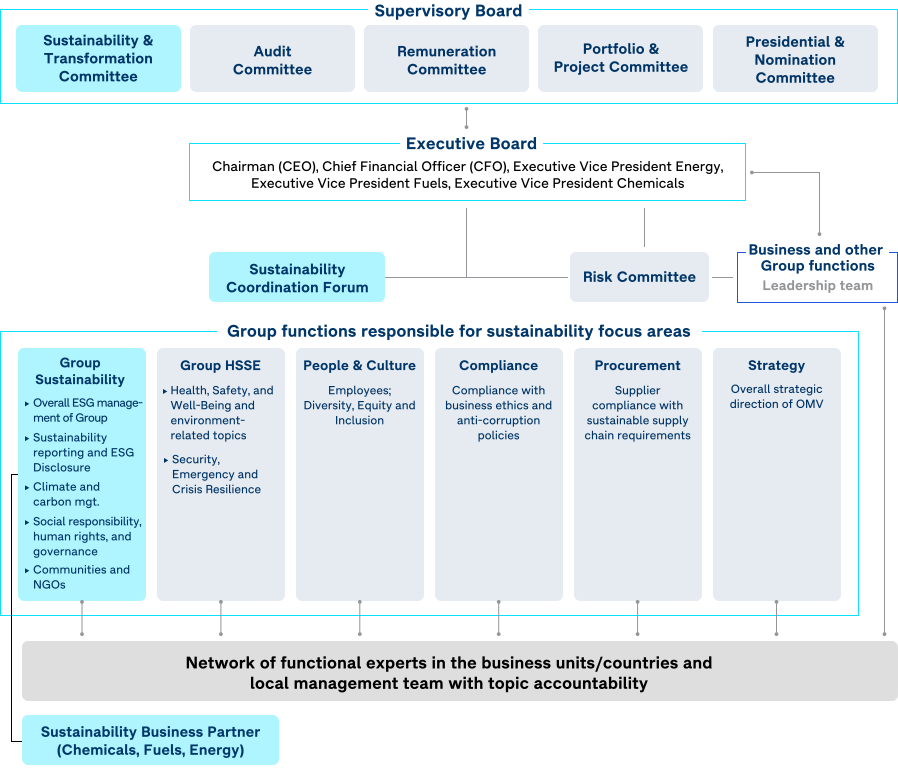
OMV has several management-level positions and committees responsible for governance processes, controls, and procedures to monitor, manage, and oversee sustainability-related impacts, risks, and opportunities. Oversight of these roles and committees is conducted through regular meetings, reporting to the Executive Board, and presentations to the Supervisory Board and its committees. The oversight of impacts, risks, and opportunities at OMV is primarily managed by the following bodies and individuals:
Supervisory Level
The Supervisory Board is the highest organizational level performing oversight of sustainability-related risks and impacts and fulfills its duties in accordance with the applicable law, particularly the Austrian Stock Corporation Act, the Company’s Articles of Association, and the Internal Rules for the Supervisory Board. The Supervisory Board, including through the Sustainability and Transformation Committee, focuses its efforts on embedding effective sustainability initiatives into strategy execution and ensuring oversight of sustainability-related impacts, risks, and opportunities. The Supervisory Board also annually reviews and approves OMV’s Sustainability Statement.
The Supervisory Board appoints from among its members qualified expert committees and determines their tasks and powers. The task of the committees is to formulate recommendations for the purpose of preparing resolutions to be passed by the Supervisory Board itself. In adequately detailed exceptional cases, the decision-making powers of the Supervisory Board can be delegated to the committees. As regards the oversight of sustainability-related impacts, risks, and opportunities at OMV, the Supervisory Board has appointed the following committees in particular:
Sustainability and Transformation Committee
The Supervisory Board’s Sustainability and Transformation Committee (STC) focuses its efforts on embedding effective sustainability initiatives into strategy execution. It meets on a quarterly basis to discuss and steer topics such as regulatory ESG requirements, which include non-financial reporting requirements, ESG-related capital market activities, ESG governance and steering, and critical concerns related to sustainabilityCritical concerns are cases that have attracted significant attention from key stakeholders, have validity (e.g., legal decisions, allegations with significant proof, etc.), are in OMV’s direct operations or value chain, and that would constitute a violation of one of the ten principles of the UN Global Compact. In 2025, one such concern was flagged and discussed by the Sustainability and Transformation Committee (2024: 3, thereof 1 update in 2025).. The purpose of the STC is to support the Company’s Supervisory Board in reviewing and monitoring OMV’s strategy with regard to sustainability, ESG-related standards, and performance, as well as processes and, specifically, performance in HSSE (Health, Safety, Security, and Environment) and climate change. Furthermore, the committee serves to support and oversee the transformation process toward a more sustainable business model, including the cultural integration of strategically significant acquisitions. At the meetings of the Supervisory Board, the Chairman of the Sustainability and Transformation Committee gives a report to the entire plenary on a quarterly basis.
Audit Committee
The Audit Committee is responsible for monitoring the effectiveness of the Company’s internal control, internal audit, and risk management systems. It reviews the functioning of these systems and reports its findings to the Supervisory Board. Additionally, the committee monitors the independence of auditors and reviews audit fees and activities. Internal Audit, which reports to the Executive Board and Audit Committee, provides an evaluation of the effectiveness of governance, risk management, and internal control processes, ensuring that appropriate controls and processes are in place and operating effectively.
Management Level
The Executive Board is responsible for managing OMV’s impact on the economy, environment, and people, including oversight of material topics such as climate change mitigation, human rights, and safety. The Executive Board takes a proactive stance in overseeing and enhancing OMV’s risk management processes, ensuring a strong risk culture across OMV and driving the risk management program. The CEO and CFO are specifically involved in human rights oversight, receiving briefings on human rights impacts twice a year. Additionally, management is involved in assessing and managing climate-related risks and opportunities, as outlined in the TCFD recommendations index. The Executive Board also oversees OMV’s compliance management system, which includes business ethics, anti-corruption, competition law, and trade sanctions.
The Executive Board fulfills its duties, including risk management oversight, in accordance with the applicable law, particularly the Austrian Stock Corporation Act, the Company’s Articles of Association, and the Internal Rules for the Executive Board. As an incentive for the Executive Board, the Remuneration Policy effective from 2024 integrates GHG and ESG targets related to material impacts, risks, and opportunities into the annual bonus and Long-Term Incentive Plan (LTIP), as approved at the June 2022 Annual General Meeting. OMV Aktiengesellschaft also complies with the Austrian Code of Corporate Governance, which aims to establish a system of management and control that is accountable and oriented toward creating sustainable, long-term value.
The Executive Board is responsible for setting and implementing the Company strategy and holds accountability for strategic targets including sustainability targets. It meets at least every two weeks to exchange information and make decisions on matters requiring plenary approval. Corporate functions such as Investor Relations & Sustainability, Group HSSE, Strategic Planning & Projects, People & Culture, Compliance, and Procurement, all of which report directly to the Executive Board, have ownership for material sustainability matters and are responsible for defining and implementing sustainability initiatives in collaboration with Group Sustainability and the business divisions. These functions regularly report on the progress of the implementation of OMV’s Sustainability Framework to the Executive Board. The Remuneration Committee evaluates the performance of the Executive Board, including sustainability criteria, and establishes criteria derived from OMV’s Strategy 2030, with a focus on reducing GHG emissions.
Risk Committee
The Risk Committee, chaired by OMV’s CFO, ensures that the risk management process effectively captures and manages material risks across OMV. Management is tasked with implementing appropriate mitigation strategies for identified risks and is responsible for ensuring the effectiveness of these strategies through a structured process of risk identification, assessment, and evaluation.
Sustainability Coordination Forum
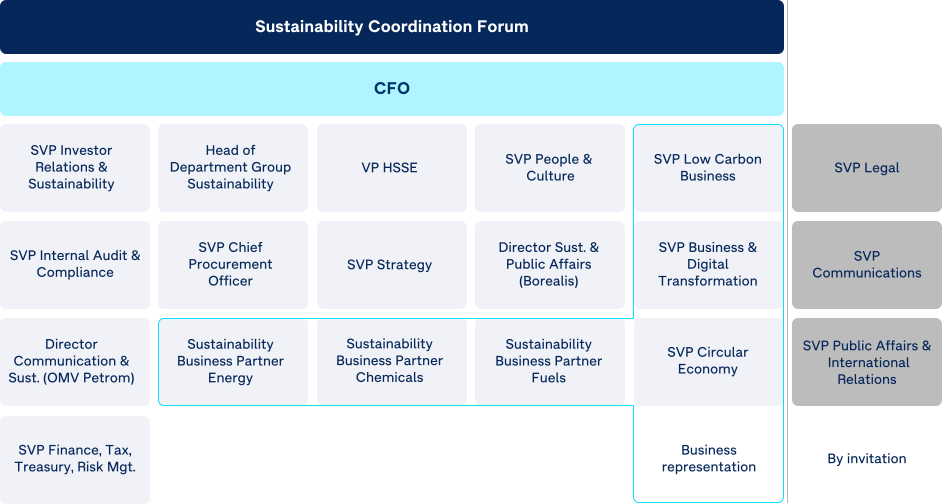
In 2023, a committee called the Sustainability Coordination Forum was formed under the Executive Board. This committee is chaired by OMV’s CFO and consists of senior managers with responsibility and ownership for material matters, as well as relevant business representatives responsible for implementing OMV’s sustainability and transformation agenda. Its mandate is to coordinate the development of the sustainability agenda across OMV, monitor progress on target achievement, propose measures in the event of deviations, and prepare sustainability matters to be discussed by the Executive and Supervisory Boards. The committee meets at least every two months.
Group Sustainability Department
Under the responsibility of the CFO, the Group Sustainability department develops OMV’s Sustainability Framework, defines the minimum requirements for sustainability management in OMV, ensures governance and ownership of material matters, and is responsible for ESRS-compliant sustainability reporting and ESG disclosure. In close collaboration with the material topic owners, who act as experts for their respective sustainability matters, the Group Sustainability department drives the overarching sustainability agenda for all material matters, integrated into the overall execution of OMV’s strategy. Group Sustainability reports quarterly on the progress of the implementation of OMV’s Sustainability Framework to the Executive Board and Supervisory Board.
The Sustainability Framework, developed by the Group Sustainability department, consists of OMV’s material sustainability matters and material impacts, risks, and opportunities (IROs), targets/ambitions, key performance indicators, actions, and management responsibilities for each material matter. The owner of a material topic is the key driver of that topic and is responsible for translating the ESRS requirements into business action plans, as well as implementing dedicated resources, controls, and procedures to identify and manage the respective impacts, risks, and opportunities related to both our own operations and the value chain, all according to the requirements and processes defined by OMV Group Sustainability. All targets related to OMV’s material impacts, risks, and opportunities are developed by the owner of the material topic with oversight of Group Sustainability and are detailed within OMV’s Sustainability Framework. This is then presented to the Sustainability Coordination Forum and OMV Executive Board for approval, ensuring senior executive management oversight. Progress toward achieving these targets is monitored annually by material topic owners and Group Sustainability and reported at least annually by Group Sustainability to the Sustainability Coordination Forum, OMV Executive Board, and the OMV Supervisory Board Sustainability and Transformation Committee.
Corporate Risk Management Function
This independent function within the CFO area reports directly to the Executive Board and Audit Committee twice per year on the outcome of Group risk reporting exercises and is independent of the business lines, thus ensuring effective risk governance. OMV has established comprehensive risk management processes that integrate the management of impacts, risks, and opportunities into other internal functions. The risk management process combines bottom-up and top-down approaches, ensuring that every employee is responsible for implementing appropriate mitigation strategies. Risks are identified and assessed using a standardized methodology that includes environmental aspects and impacts. The process is facilitated by a Group-wide IT system supporting risk identification, analysis, evaluation, treatment, and review, guided by the ISO 31000/27000 series. The integration with internal functions is reinforced through a cross-functional Risk Committee chaired by the OMV CFO, involving senior management members. This committee ensures that material risks are captured and managed effectively across OMV. Moreover, the risk management processes are centrally coordinated by the Risk & Insurance Management department to ensure consistent application of risk management tools and techniques across the organization.
Ethical Business Conduct
The administrative, management, and supervisory bodies at OMV are crucial in ensuring ethical business conduct within the Group. The Executive Board sets and upholds OMV’s ethical standards, while both the Executive and Supervisory Boards hold ultimate responsibility for ensuring OMV’s ethical conduct while generating economic value. All members of these boards receive extensive training. There are also regular meetings with the entire EB and with each individual member of the EB, regular Audit Committee meetings with the SB, and meetings with the chairperson of the SB, during which compliance-related matters are reported and discussed.
Responsibility for managing matters related to ethical business conduct, including our material sub-topic of corporate culture and matters related to anti-corruption and anti-bribery (relevant for NaDiVeG), is distributed across several departments rather than being centralized in one. For instance, the OMV Compliance Management System is implemented Group-wide through collaboration between central management units and local compliance officers in all countries in which OMV operates. The responsibility for defining and embedding our corporate culture within the company lies with the People & Culture (P&C) team, which reports directly to the OMV Group Senior Vice President (SVP) of P&C. The final endorsement of the values and policies that guide our corporate culture lies with the Executive Board. For more information, see G1 Business Conduct.
Skills and Expertise Related to Overseeing Sustainability Matters
Related to all the functions described above, the administrative, management, and supervisory bodies at OMV can draw on several mechanisms to ensure that the appropriate skills and expertise are available or will be developed to oversee sustainability matters. A self-assessment of the Supervisory Board to review the activities of the Supervisory Board and its committees is performed on an annual basis with support from an external consultant. The evaluation carried out in January 2026 for the full year 2025 produced overall positive results. In particular, the Sustainability and Transformation Committee received high ratings for its role in overseeing environment-related processes and environmental performance. Through annual training programs on relevant topics, including ESG-related fields, the Supervisory Board gains the experience required to oversee ongoing and upcoming sustainability matters. For instance, in 2023, the program included an external presentation on the IPCC Sixth Assessment Report on Climate Change. In 2024, the Supervisory Board had a training session on the requirements of the CSRD and ESRS and a risk awareness training session focused on OMV’s Enterprise-Wide Risk Management program. The members of the Executive Board also participated in this training. In 2025, the Sustainability and Transformation Committee held deep dives on sustainability topics such as GHG and ESG performance, process safety, cultural transformation, circular economy solutions, sustainable supplier management, the sustainability and environmental performance of the Neptun Deep project, and the priorities of the European Commission’s sustainability agenda.
The skills and experience within the Company are connected to sustainability impacts, risks, and opportunities through the qualifications and expertise of individuals involved in reviewing and proposing policies, actions, and targets. The 2024 training session for the Supervisory Board on the CSRD and ESRS also focused on the double materiality principle for identifying and assessing impacts and risks, as well as discussing the results of OMV’s materiality assessment. Regarding business conduct matters in particular, the members of the Supervisory and Executive Boards possess relevant expertise, as they receive comprehensive training from the Compliance team on all relevant compliance topics. The Supervisory and Executive Boards also have access to sustainability-related expertise through events such as regular briefings from internal sustainability teams, consultation with external experts, and participation in industry forums. OMV also provides ongoing training and educational initiatives, such as targeted training on sustainability-related matters including OMV’s material topics and material IROs, as well as risk management, as described above.