In 2025, OMV achieved a solid clean CCS Operating Result of EUR 4.6 bn. Cash flow from operating activities including net working capital effects remained significant, amounting to EUR 5.2 bn, and organic free cash flow totaled EUR 1.5 bn. The leverage ratio was 14%. This financial strength is an excellent basis for OMV’s ongoing strategic transformation into an integrated sustainable energy, fuels, and chemicals company, and its commitment to delivering attractive shareholder returns.
Business Environment
Macroeconomy
Global Gross Domestic Product (GDP) growth remained underwhelming in 2025. International Monetary Fund (IMF) projections put 2025 annual GDP growth at 3.3% with a decelerating trend throughout the year, remaining below the 2010–2019 average.IMF World Economic Outlook, January 2026
In April 2025, the United States announced the imposition of sizable tariffs on most of its trade partners, in a major departure from previous trade policy rules and norms. Nevertheless, its negative impact on GDP has been moderate as US firms front-loaded imports in the first half of the year and the private sector swiftly reorganized supply chains and redirected trade flows. The negotiation of trade deals between various countries and the US kept global trade broadly open.
Contrary to previous episodes of trade tensions, the US dollar depreciated, reflecting increased hedging demand by non-US investors and a potential market reassessment of the dollar. While a weaker dollar amplified the tariff shock for US domestic consumers, it also supported global trade, contributed to favorable global financial conditions, and eliminated inflationary pressure from exchange rate pass-through. In this way, it provided policymakers (especially those in emerging markets and developing economies) with room to support their economies. On the other hand, sizable cuts in development aid weighed on emerging economies. Official development assistance dropped by 9% in 2024 and a drop of similar magnitude was expected for 2025, based on announced cuts by major donors.
Growth rates continued to remain uneven, with different factors exerting influence in different regions. The US economy continued to outperform other developed economies, driven by investments in equipment and intellectual property – including AI. However, weakening labor markets and slowing construction activity impacted the economy negatively. Economic performance in the euro area remained subdued in 2025 driven by weak economic performance in Germany and Italy. The Chinese economy started showing signs of weakness from the second quarter onward due to receding net exports, which were only partially offset by domestic demand. Japanese GDP saw some improvement during the year amid increased capital spending and rising exports – especially cars.
Global headline inflation decreased further, from an average of 5.8% in 2024 to 4.1% in 2025. So far, the impact of trade uncertainties has been marginal, as stockpiling and tariff pauses – among other factors such as trade diversion and rerouting – led to a lower-than-anticipated effective tariff rate. In the second half of 2025, inflation showed signs of acceleration in developed economies as the impact of tariffs was no longer being absorbed within supply chains. However, easing tightness in labor markets was expected to help inflation return to policymakers’ target levels.
Global trade activity was robust in the first quarter of 2025, driven by strong growth in US imports and in exports from Asia and the euro area because of front-loading in anticipation of higher tariffs in the United States. Some of this strength could be related to a weaker dollar. Subsequent data showed signs of deceleration in the second quarter. Goods exports to the United States from major European economies – particularly Germany, Spain, and the United Kingdom – fell notably. Total euro area exports remained resilient, however, supported by larger trade flows within Europe. In China, the decline in exports to the United States was partly offset by higher exports to the euro area and countries in the Association of Southeast Asian Nations (ASEAN), in part supported by the depreciation of the renminbi against most currencies (excluding the US dollar).
Oil
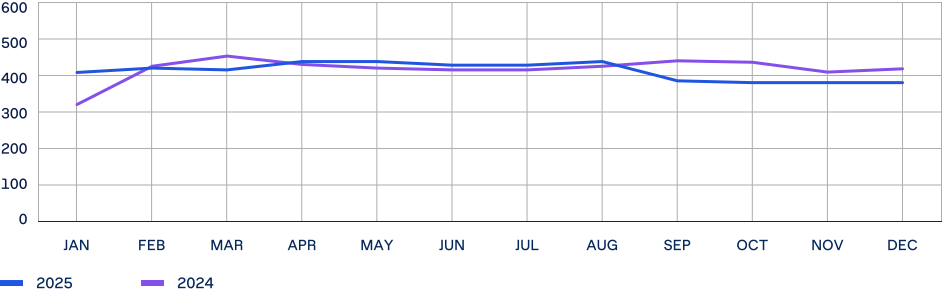
The oil market was softer in 2025 than in the prior year. After averaging around USD 81/bbl in 2024, Platts Dated Brent averaged some 14% lower than the previous year at approximately USD 69/bbl. With trade flows in crude and products more accustomed to the various sanctions and trade frictions introduced since 2022, the market was characterized by downward pressure over the course of the year as supply continued to increasingly outpace demand. The major change on the supply side was policy-driven, with a massive unwind of the 2023 supply cuts by OPEC countries. This saw more than 2 mn bbl/d of crude supply returned to the market in the space of less than six months from April onward. While the trajectory for demand growth in 2025 was not as soft as expected when the US announced a major shift in trade policy in Q2, it nevertheless remained muted by the standards of recent history. Downside in oil prices may have been limited by strategic buying in China, which according to some sources averaged at a level that offset a meaningful portion of the returning OPEC supply. At the same time, the marked weakening in the dollar against the currencies of several oil-importing nations may also have protected the USD-denominated oil prices from some additional weakness.
Crude price (Brent) – monthly average1
In USD/bbl
Natural Gas
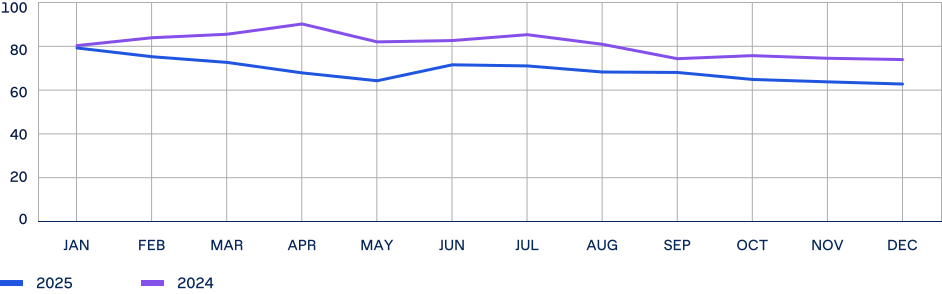
The trajectory of natural gas prices in European hubs was a reversal of that seen in the prior year, with higher prices in the early part of the year gradually giving way to lower prices toward the close of 2025. This nevertheless resulted in a slight increase in the average price level compared to the previous year. 2024’s average of around EUR 35/MWh was surpassed by around 8%, compared to the 2025 average of approximately EUR 37/MWh. The gas market in Europe was characterized by moderate growth, especially in the power generation sector, with periods of low renewables output in the early part of 2025. Gas prices fell from high levels in the first quarter, with incremental increases in LNG coming into the market. A key driver of lower prices was also the relative softness of natural gas demand in Asia, where demand growth was much more limited than in the preceding couple of years. This restricted the amount of competition for LNG cargoes, allowing Europe to remain well-supplied with cargoes even at lower price levels. The easing of EU storage mandates ahead of the withdrawal season was also seen to contribute to the decline to price levels below EUR 30/MWh by the end of 2025.
Natural gas price (THE) – monthly average1
In EUR/MWh
OMV Refining Indicator Margin Europe
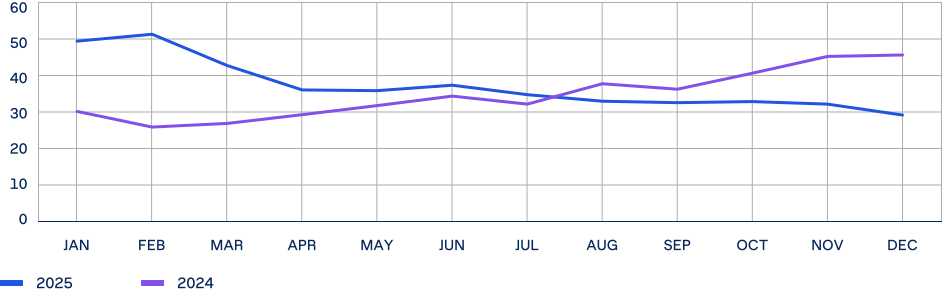
The refining margin averaged around USD 10.1/bbl in 2025, a significant increase compared to USD 7.2/bbl in 2024, driven by strength in the second half of the year due to supply tightness. Naphtha crack spreads remained rangebound slightly below the historical average. Petrochemical demand remained under pressure amid macroeconomic headwinds. However, easing outright price levels, Ukrainian attacks on Russian refineries, and new sanctions on the Russian energy sector tightened supplies. Motor gasoline crack spreads followed seasonal patterns in the first half of the year. However, they started a counter-seasonal strengthening from August onward. Disruptions at the Dangote refinery led to more exports from Europe to West Africa, while strong middle distillate crack spreads incentivized refineries to maximize middle distillate production at the expense of light distillates, tightening supplies for motor gasoline. Middle distillate crack spreads started increasing in June: at first, import economics from the Middle East became more complicated due to the Iran-Israel conflict, with freight and insurance costs skyrocketing. Intensifying Ukrainian attacks on Russian refineries also tightened middle distillate balances. In the second half of October, the US government sanctioned Lukoil and Rosneft, which gave an additional boost to the already strong refinery margins until the second half of November. At the end of the year, margins returned to late summer levels, with the market sentiment easing as Russian exports rebounded and peace talks regarding Ukraine intensified.
Refining indicator margin Europe (OMV) – monthly average1
In USD/bbl
Chemicals
The weak economic environment in Europe for chemicals persisted during 2025, leading to several cracker closures, but market conditions didn’t strengthen as much as expected. While the closures helped rebalance the market, the region continued to face pressure from lower-cost imports. Further challenges to recovery came from ongoing tariffs, slowing economic growth, and geopolitical risks. The turnaround season remained as light as in the previous year. Slightly more volumes were offline in the market, but this was not sufficient for a market recovery due to weaker demand. European cracker operating rates averaged 73%, up one percentage point from the 2024 average, largely due to the permanent closures. In total, approximately 2.7 mn t of cracker capacity – equivalent to 13% of Western Europe’s total capacity – has been taken offline since the beginning of 2024.
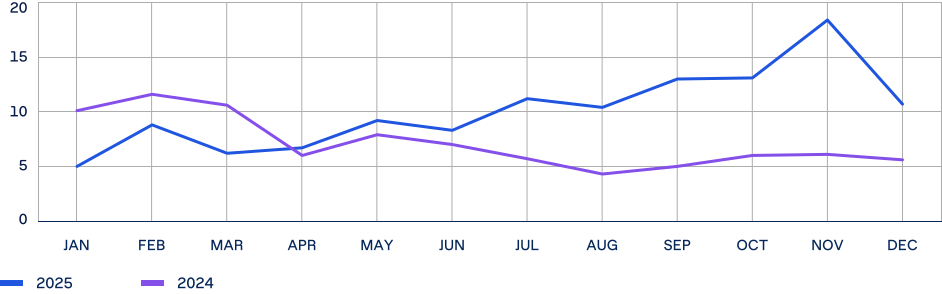
The European polyolefin market remained affected by the macroeconomic slowdown and muted demand in several sectors, especially from the key sectors of construction and automotive. The significant inflow of finished goods from China further delayed industrial recovery. The European polyolefin market faced significant import pressure throughout 2025, driven by competitive pricing from external markets and economic challenges within the region, while supply was adequate throughout the year. The market was under additional pressure from tariffs, weak oil prices, and a persistent supply-demand imbalance, compounded by high inventories and subdued sentiment amid ongoing trade tensions. In 2025, the polyethylene operating rate in Europe was 74% (2024: 72%), supported by about 7% of capacity rationalization. Despite about 3% of capacity rationalization, the European polypropylene operating rates weakened by 1% compared to 2024 to 81%, due to poor profitability, outages, and weak export demand.
Asian polyolefin demand in 2025 was under heavy pressure from structural oversupply and weak downstream demand. Tariffs, soft crude oil prices, and the persistent supply-demand imbalance weighed on sentiment, with buyers showing little appetite to build inventory. Imports into the region were constrained as overseas sellers diverted cargoes to more competitive markets, offering only marginal support to pricing. In 2025, the operating rates in Northeast Asia were 77% (2024: 79%) for polyethylene and 72% (2024: 77%) for polypropylene.
Polyolefin margins (OMV) – month-end values1
In EUR/t