
OMV fully supports the goals set forth by the Paris Agreement, and addressing climate change is central to our Group strategy. We are committed to transforming into an integrated sustainable energy, fuels, and chemicals company, with the ambition of becoming a net-zero business by 2050.The commitment “net-zero business by 2050” covers the greenhouse gas (GHG) emissions of our operations (Scopes 1 and 2) and our product portfolio and other Scope 3 emissions along the value chain. For our interim GHG targets for 2030 and 2040, Scopes 1 and 2 and the following Scope 3 categories are included: Category 11 “Use of sold products” for energy supply, Category 1 “Purchased goods” (feedstocks) from OMV’s Chemicals business segment, and Category 12 “End-of-life treatment of sold products” for non-energy use. This commitment includes not just our own operations (Scopes 1 and 2) but also our product portfolio and other emissions along the value chain (Scope 3). OMV is committed to climate change mitigation and aims to support and accelerate the energy transition.
To support OMV’s ambition of becoming a net-zero business by 2050, OMV has developed a transition plan. This plan is an integral part of the OMV Strategy 2030 and complemented by concrete short-, mid-, and long-term targets. OMV’s targets are set at both absolute and intensity levels, with the ultimate goal of achieving net zero greenhouse gas (GHG) emissions in Scopes 1, 2, and 3 by 2050. For Scopes 1 and 2, OMV is aiming for an absolute reduction of 30% by 2030 and 60% by 2040. For the defined categories in Scope 3, OMV is aiming for an absolute reduction of 20% by 2030 and of 50% by 2040. These absolute GHG emission reductions and the increase in zero-carbon energy sales are key in reducing the carbon intensity of our energy supply, pursuing a decline of 10% by 2030 and of 25% by 2040. These targetsThe intensity target was revised in 2025. were first set in 2021 and are approximated to the IEA’s Sustainable Development Scenario (SDS) for 2030. However, our target of achieving net zero emissions by 2050 is significantly more ambitious than the emission reduction pathway of the Sustainable Development Scenario. The base year 2019 is used for these targets, as it was the last full year before the COVID-19 pandemic and the majority of OMV’s assets were operating throughout that year. For further details on our climate targets, see E1-4 Targets Related to Climate Change Mitigation and Adaptation.
The climate targets guiding OMV’s transition plan were approved by the Executive and Supervisory Boards. Strategic actions to deliver on OMV’s transition plan and achieve our climate targets are approved by OMV’s Executive Board through the Company’s mid-term planning and investment approval processes. The achievement of the targets is also a key element of the Executive Board’s remuneration; for details, see GOV-3 Integration of Sustainability-Related Performance in Incentive Schemes. Carbon emission reductions are further overseen by OMV’s Supervisory Board, supported by the Sustainability and Transformation Committee (STC); for details regarding oversight and responsibilities for sustainability matters, see GOV-1 Role of the Administrative, Management, and Supervisory Bodies. One of the STC’s responsibilities is to review and evaluate the progress OMV is making toward its climate change and energy transition objectives. Jointly, the STC and the Supervisory Board review and approve the OMV Group Sustainability Statements every year, which includes the transition plan.
Decarbonization Levers
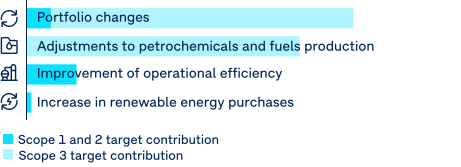
To achieve our targets, OMV is committed to adjusting its business model and taking climate action across various areas categorized according to the decarbonization levers described below. These levers group investments identified as part of OMV’s mid-term planning to deliver on OMV’s Strategy 2030 (see Directors’ Report: Strategy), based on their contribution to its climate targets (for details, see E1-3 Actions and Resources in Relation to Climate Change Policies). OMV’s mid-term planning process and thus the derived decarbonization levers are informed by OMV’s scenario analysis; for details, see ESRS 2 SBM-3 Material Impacts, Risks, and Opportunities and Their Interaction with Strategy and Business Model and Note 3 – Effects of climate change and the energy transition.
Decarbonization lever |
|
Estimated contribution to absolute GHG reduction targets 2019–20301 |
|||
|---|---|---|---|---|---|
|
|
Scope 3 |
|||
Improvement of operational efficiency |
This decarbonization lever includes initiatives that aim to optimize and decarbonize our operational processes, increase energy efficiency, electrify operations, install photovoltaic systems to power our own operations, reduce flaring and venting, and reduce methane emissions through leak detection and improvements to asset integrity. |
62% |
|
||
Increase in renewable energy purchases |
OMV is increasingly turning to renewable sources of electricity to power our own operations. One way of doing this is by purchasing renewable energy, which subsequently reduces our Scope 2 emissions. |
7% |
|
||
Adjustments to petrochemicals and fuels production |
A growing share of sustainable (renewable and recycled) feedstock for fuel and chemical production at our integrated sites in Schwechat and Burghausen supports OMV’s decarbonization strategy. |
|
47% |
||
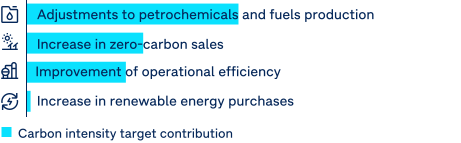
Increase in zero-carbon sales |
Incorporating renewables into our sales portfolio by significantly increasing sustainable and biobased fuels, green gas sales, electric vehicle charging, and photovoltaic electricity capacity alongside geothermal energy means we are actively reducing the carbon intensity of our energy supply. |
No absolute GHG impact, but contribution to reduction of carbon intensity of energy supply |
|||
Portfolio changes |
Implementing any other strategic portfolio changes through acquisitions and investments, decommissioning and divesting assets, and optimizing our oil and gas portfolio focusing on gas as a transition fuel will help us reduce emissions and achieve our climate targets. |
31% |
53% |
||
CCS/CCU |
Investing in Carbon Capture and Storage (CCS) capacity as an abatement measure will support our efforts to achieve climate targets. |
Contribution after 2030 |
|||
|
|||||
Decarbonization Measures to Meet OMV’s 2030 Climate Targets with the Ambition of Reaching Net Zero by 2050
Absolute net GHG Scope 1 and 2 emissions
[mt CO2e]
![Absolute net GHG Scope 1&2 emissions [mt CO2e] (graphic)](../../../_assets/gallery/sst-energy-transition-absolute-1.svg?h=DgkJTUEv)
Absolute net GHG Scope 3 emissions
[mt CO2e]
![Absolute net GHG Scope 3 emissions [mt CO2e] (graphic)](../../../_assets/gallery/sst-energy-transition-absolute-2.svg?h=Xm5NvoC7)
Contribution of measures to absolute GHG emission reduction target for 2030
Carbon intensity of energy supply, Scopes 1, 2, and 3
[g CO2e/MJ]
![Carbon intensity of energy supply Scope 1, 2, 3 [gCO2e/MJ] (pie chart)](../../../_assets/gallery/sst-energy-transition-intensity.svg?h=mKE0cbco)
Contribution of measures to carbon intensity reduction target for 2030
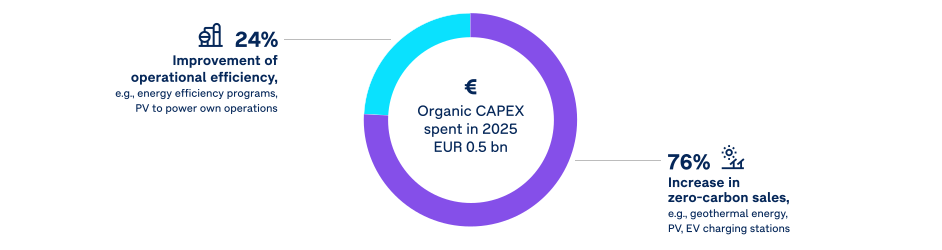
CAPEX in 2025 to achieve climate targets1
Investments in Support of the Transition Plan
To support OMV’s Strategy 2030, the Company plans to allocate average yearly organic CAPEX of approximately EUR 2.8 bn between 2026 and 2030. Of this, 30% will be directed toward sustainable projects. In line with OMV’s Sustainability Framework, this includes projects that are either EU Taxonomy-aligned or contribute to achieving OMV’s GHG targets, such as geothermal projects, renewable electricity, mechanical and chemical recycling, and biofuels. Approximately 25% of the CAPEX for sustainable projects will be dedicated to OMV’s Energy segment, and 75% to Chemicals and Fuels. For more details, see E1-3 Actions and Resources in Relation to Climate Change Policies.
On average, 76% of the sustainable project investments are likely to be aligned with the EU Taxonomy over the mid-term planning period from 2026 to 2028. OMV’s CAPEX plan to further expand Taxonomy-aligned activities is based on the latest Supervisory Board-approved business plan. It is subject to review and potential changes. It does not account for Taxonomy-eligible activities that have not been claimed as Taxonomy-aligned since 2022, but which may align with Taxonomy criteria in the future, such as geothermal activities. In 2025, OMV’s EU Taxonomy-aligned CAPEX represented an 18.4% share of its total CAPEX, which is likely to increase to 19% over the mid-term planning period from 2026 to 2028. For more details, see Taxonomy-Eligible and Taxonomy-Aligned CAPEX. OMV is excluded from the EU Paris-aligned benchmarks. Significant CAPEX invested in 2025 in economic activities related to oil and gas amounted to EUR 2 bn.
Progress on Transition Plan Implementation
OMV is actively progressing with the implementation of its transition plan; for details, see Progress on Specific Key Actions. OMV has also improved its energy and operational efficiency, contributing to a reduction in absolute Scope 1 and 2 emissions by 26% compared to 2019. Scope 3 emissions have been reduced by 19% compared to 2019, driven by lower fossil fuel sales. To achieve this progress, OMV invested EUR 0.5 bn in 2025. In 2025, 16.6% (2024: 22.4%) of OMV’s total CAPEX was classified as Taxonomy-eligible (non-aligned) and 18.4% (2024: 18.7%) as Taxonomy-aligned.
1.5°C Alignment
When assessing the alignment of OMV’s climate targets with a 1.5°C world, several scenarios and approaches were explored, as no guidance is available for an integrated energy, fuels, and chemicals company. One of the main starting points for OMV’s assessment was the suite of scenarios underpinning the Sixth Assessment Report by the Intergovernmental Panel on Climate Change (IPCC), particularly its C1 scenarios, in which global warming is limited to 1.5°C with no or limited overshoot (>50% probability). By examining global energy-related GHG emissions (CO2, CH4, and N2O) but excluding emissions from coal to better reflect OMV’s business, a wide range of around 70 scenarios opens up to 2030 and beyond. The emissions were normalized to 100% for 2019, the base year for OMV’s climate targets. Then, 5% each of the extreme lower and upper outliers were removed to condense this spectrum of scenarios. All of OMV’s targets fall within this range, indicating alignment with a 1.5°C world (see figure below). For OMV’s Scope 3 targets in 2030 and 2040, approximately 40% and over 20%, respectively, of the analyzed IPCC scenarios are characterized by less ambitious CO2 emissions reductions.
Alignment of greenhouse gas reduction targets
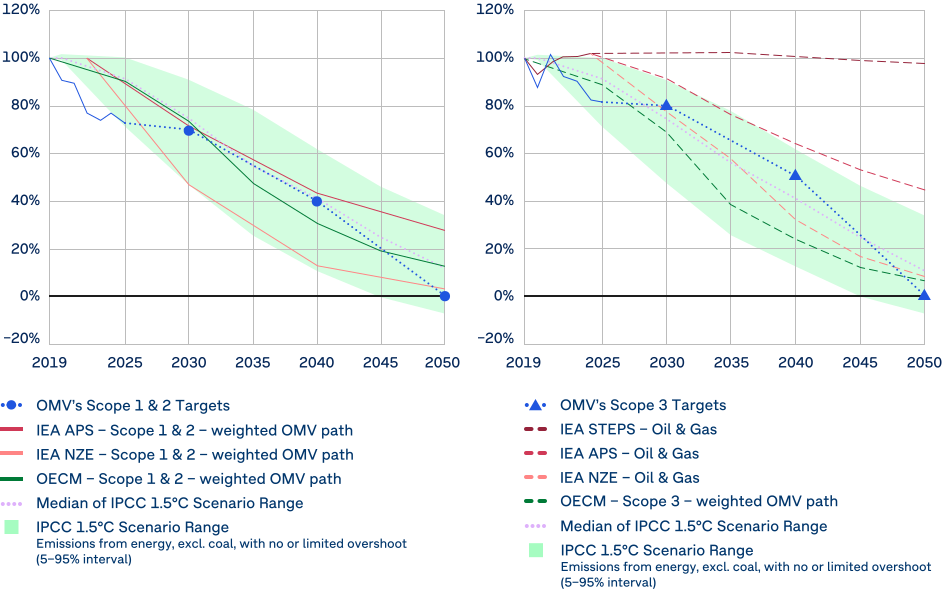
The second key source for OMV’s assessment of its climate targets is the IEA’s World Energy Outlook (WEO 2025). The main IEA scenarios used are the Net Zero Emissions by 2050 (NZE) scenario, corresponding to a 1.5°C temperature increase (50% probability), the Announced Pledges Scenario (APS),Based on the WEO 2024, as this scenario was not included in the WEO 2025. associated with a 1.7°C increase, and the Stated Policies Scenario (STEPS), pointing toward a 2.5°C rise in temperature. OMV’s 2030 Scope 3 target is very close to being aligned with the oil and gas-related emissions pathway in the NZE scenario, while the 2040 targets fall between the NZE and APS pathways.
Looking at sectoral decarbonization pathways, the IEA’s 2023 special report on The Oil and Gas Industry in Net Zero Transitions is another critical reference. For a company like OMV that will remain active in oil and gas, the IEA suggests that a capital budget share exceeding 50% should be allocated to clean energy technologies by 2030. This is considered a key criterion for making a fair contribution to achieving net zero emissions by 2050. As the IEA notes, this capital share would only be feasible for oil and gas companies if governments were to significantly reduce their tax revenues and shareholders were willing to accept lower dividends. For comparison, OMV is committed to allocating, on average, 30% of organic investmentsPotential additional inorganic investments for mergers and acquisitions are strategically selected in alignment with OMV’s Strategy 2030 and its path to net zero by 2050. to sustainable projects in the period up to 2030. The IEA report also provides Scope 1 and 2 emission pathways for oil and gas, which were combined with emissions from chemicals from the World Energy Outlook by weighting them based on OMV’s Scope 1–3 emissions according to the respective business segment in 2019. This indicates that OMV’s 2030 and 2040 targets align with the resulting APS pathway, but not the NZE. In the NZE scenario, for oil and gas operations alone, Scope 1 and 2 emissions should fall by more than 60% by 2030. Recognizing that achieving this could be challenging for companies with extensive past reduction efforts, the IEA suggests alternative 2030 emissions intensity targets for upstream oil and natural gas as well as oil refining. Based on the intensity targets, OMV’s Scope 1 and 2 targets are approximately 70% aligned with the outcomes of the NZE scenario.
However, the comparison with the intensity targets covers only about one-third of OMV’s current total target-relevant Scope 1 and 2 emissions and thus doesn’t encompass a significant portion of OMV’s operations. In general, the IEA’s guidance for the oil and gas industry on alignment with the NZE scenario does not fully apply to OMV, as it excludes OMV’s chemicals business. This limitation specifically applies to the IEA’s emissions intensity target, which is designed for conventional oil refineries. To make a meaningful comparison with the IEA’s targets, it is necessary to exclude the Chemicals business and its associated emissions from OMV’s petrochemical integrated sites at Schwechat and Burghausen. This exclusion results in a somewhat narrower scope for the remaining oil refinery business, with lower associated emissions and thus a more positive outcome.
To complete the picture with a pathway for Chemicals, the One Earth Climate Model (OECM) is used as a reference. Commissioned by the UN-convened Net-Zero Asset Owner Alliance and the European Climate Foundation, the OECM provides distinct sectoral decarbonization roadmaps for oil, gas, and chemicals. Compared to the IEA’s NZE scenario, it assumes a lower carbon budget, no fossil fuels for energy use by 2050, and no role for any carbon capture technologies such as CCS. Consequently, especially looking toward 2040, the role of oil and gas is significantly lower than in the IEA’s NZE scenario. The OECM’s exclusion of CCS is not in line with OMV’s strategy, which considers CCS as a key element for being able to reach net zero by 2050. However, this implies that successful global deployment of carbon capture technologies may increase the available carbon budget, providing more leeway in the OECM sectoral decarbonization pathways.
As for the IEA scenarios, the OECM oil, gas, and chemicals pathways were weighted and combined to reflect OMV’s business structure. This demonstrates clear alignment with a 1.5°C pathway to 2030 for Scope 1 and 2 emission targets. By 2040, OMV would miss the combined OECM pathway. However, the weighting will need to be reassessed after the closing of the Borouge Group International (BGI) transaction, which is expected to happen in 2026, comprising the combination of Borouge and Borealis and the acquisition of NOVA Chemicals. As Borealis would be deconsolidated as part of this deal, the 2019 emissions baseline would require a recalculation. This would significantly reduce the weighting of the OECM chemicals pathway. As it is the most ambitious regarding Scope 1 and 2 emission reductions compared to oil and gas, this would improve OMV’s alignment with the aligned 1.5°C pathway. In contrast, OMV’s Scope 3 targets clearly do not align with the combined OECM pathway. After the closing of the BGI transaction they would, however, come closer to doing so in 2030.
Scopes 1 & 2 |
|
Temperature outcome |
Alignment |
||
|---|---|---|---|---|---|
Paris Agreement |
|
well below 2°C |
Aligned |
||
IEA |
APS Pathway |
1.7°C |
Aligned |
||
NZE CAPEX |
1.5°C |
60% of target value |
|||
NZE Intensities1 |
~70% aligned |
||||
NZE Pathway |
Not aligned |
||||
OECM Pathway |
|
1.5°C |
Aligned |
||
|
|||||
Scope 3 |
|
Temperature outcome |
Alignment |
|---|---|---|---|
Paris Agreement |
|
well below 2°C |
Aligned |
IPCC pathways |
|
1.5°C |
Within range |
IEA |
APS pathway |
1.7°C |
Aligned |
NZE pathway |
1.5°C |
Nearly aligned |
|
OECM Pathway |
|
1.5°C |
Not aligned |
While OMV’s climate targets are clearly aligned with the Paris Agreement’s goal of limiting global warming to well below 2°C, assessing compatibility with a 1.5°C world presents a more nuanced picture due to the lack of binding guidance for the oil, gas, and chemicals industry and the limited number of credible sector-specific decarbonization pathways. At this stage, OMV is confident that its Scope 3 emission reduction targets for 2030 are compatible with limiting global warming to 1.5°C and Scope 1 and 2 targets with a 1.7°C temperature increase. As new scenarios and guidance become available, OMV will revisit its 1.5°C assessment and adjust conclusions accordingly.
Locked-In Emissions
Key Assets, Associated Sources of Emissions, and Reduction Measures
Locked-in emissions refer to future greenhouse gas emissions expected to arise from OMV’s active and firmly planned key assets or products sold throughout their operational lifespans. OMV’s key assets concerning locked-in emissions can be classified as followsOMV’s Combined Annual Report 2024 also listed the chemicals businesses in Kallo, Stenungsund, and Porvoo as key assets. As part of the creation of Borouge Group International (BGI), Borealis – which includes these assets – is expected to be deconsolidated in 2026. Accordingly, the locked-in emissions of these assets will then be managed by BGI.: the refineries in Schwechat, Burghausen, and Petrobrazi, the Brazi power plant and the Exploration & Production (E&P) businesses in Romania and Austria. Around 60% of the locked-in emissions up to 2030 are associated with the refineries, while the Brazi power plant contributes around one-fifth to the total, with E&P Austria and Romania contributing the remainder. Jointly, these key assets will account for over 90% of OMV’s total Scope 1 and 2 greenhouse gas emissions from 2025 to 2030. To reduce these emissions, OMV is continuously optimizing its operations and facilities to improve their energy efficiency. The measures identified across all key assets will bridge the gap to meet OMV’s 2030 Scope 1 and 2 targets, with around three-quarters of the reductions of locked-in emissions up to 2030 coming from the Schwechat refinery and Brazi power plant.
Locked-in Scope 1 and 2 emissions from key assets from 2025 to 2030, after implementation of emission reduction measures
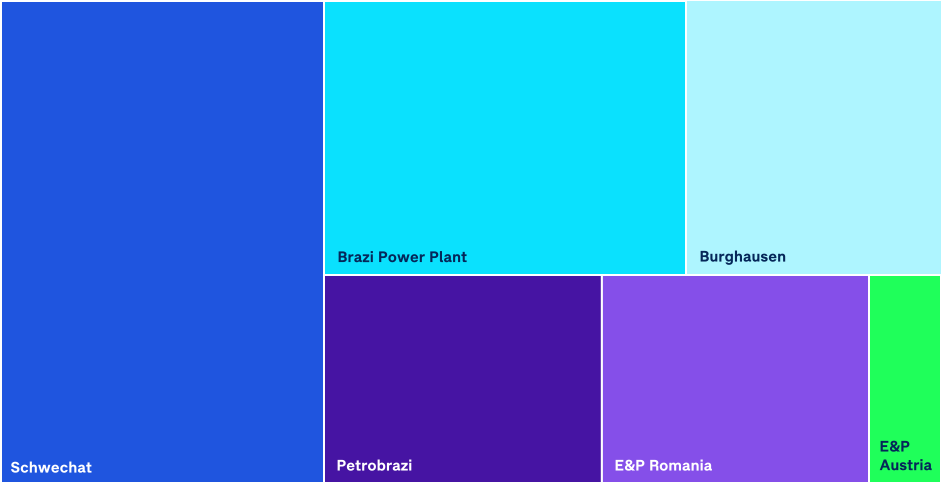
The main emission sources and potential emission reduction measures for these three asset types include the following:
Refineries
OMV’s refineries, especially those in Austria (Schwechat) and Germany (Burghausen), are petrochemically integrated sites. They supply Borealis and other customers with petrochemical monomers in addition to the traditional fuels business, which provides road and aviation fuels. Greenhouse gas emissions from the refineries include emissions from the process plants, e.g., for the production of fuels and other products (such as hydrotreating facilities, crude distillation, or bitumen processing), which are partially required for petrochemical upstream processes, plus emissions from steam crackers producing petrochemicals and from the utility plants required for electricity and steam generation. Emission reduction measures to be implemented by 2030 – such as the use of green hydrogen as well as energy efficiency measures – are currently being examined. Looking beyond 2030, OMV will continue to reduce CO2 emissions by further adapting the future product portfolio to more sustainable (renewable and recycled) products and by decarbonizing the remaining process units, through means such as electrification or more sustainable process fuels.
Brazi Power Plant
OMV Petrom’s Brazi power plant is a combined cycle power plant with a total capacity of 860 MW, providing approximately 10% of Romania’s electricity generation. Emission reductions could be achieved through various technical pathways, such as operating at a lower capacity factor or incorporating clean fuel sources as a complement to natural gas (such as biomethane or hydrogen). However, the viability and maturity of these technical pathways and the evolution of the market (including demand, pricing, and the regulatory environment) require consideration.
Exploration & Production
OMV Petrom’s E&P business in Romania operates around 150 commercial oil and gas fields with approximately 6,000 production wells, 9,000 km of pipelines, and around 900 processing facilities. Collectively, these operations currently produce around 110 kboe/d. From 2027 onward, the Neptun Deep project is anticipated to add up to 70 kboe/d at its plateau to OMV Petrom’s natural gas production. In Austria, some 1,000 wells produce over 15 kboe/d. The largest share of the Scope 1 emissions from E&P Romania (~70%) and Austria (~60%) is caused by the fuel gas consumption for producing and processing oil and gas, such as in the operation of compressors and steam generation. Scope 2 emissions are associated with the power and steam purchased and consumed.
Emission reductions are expected to naturally occur in line with production decline over the lifetime of the oil and gas fields. In E&P Romania, energy efficiency improvements, process optimization, field modernization, and integrity improvements are the main measures considered to reduce Scope 1 emissions by 2030. In E&P Austria, the replacement of gas-driven compressors with electric ones is the main measure considered to reduce Scope 1 emissions by 2030 and beyond, in addition to the production decline. By 2040, emissions associated with the current operations are expected to drop significantly to less than half of current levels. This is mostly due to the production decline, but also the switch to renewable power consumption.
Emissions of Sold Products
The locked-in emissions associated with the products OMV sold in the reporting year (Scope 3, Category 11), as defined by ESRS, represented over 49% of OMV’s total Scope 3 emissions (76.0 out of 154.3 mn t CO2e) in 2025. These emissions are directly related to the combustion of the oil and gas products sold for energy use, meaning they occur largely in the reporting year and are not locked in for many years to come. Instead, they reduce year by year in line with OMV’s Strategy 2030 and our aforementioned climate targets and decarbonization levers.
Impact of Locked-In Emissions on GHG Reduction Targets
OMV’s emission targets cover 100% of Scope 1 and 2 greenhouse gases from the key assets listed previously and 97% of the emissions from sold products (as Chemicals is excluded). OMV’s 2030 climate targets are integral to the Strategy 2030 and associated business objectives, and their achievement is a key element of the Executive Board’s remuneration. Accordingly, OMV utilizes a unified planning process to achieve both business and climate objectives. The locked-in emissions from OMV’s key assets and sold products are thus factored into OMV’s strategy and its implementation, ensuring they do not jeopardize meeting OMV’s 2030 emissions targets in line with current expectations. Looking toward 2040 and 2050, further options for reducing emissions in line with OMV’s climate targets include switching to more sustainable fuels and feedstocks, as well as decarbonization measures like increased electrification, carbon capture technologies, and other emerging solutions. The final selection of measures for implementation will depend on how legal frameworks evolve, the availability of technologies and supporting infrastructure (e.g., pipelines for hydrogen or CCS), and the market demand for, and supply of, more sustainable products. By 2050, OMV expects to compensate for any remaining locked-in emissions to achieve net zero emissions. Implementing sophisticated decarbonization projects presents challenges in terms of financing, timing, and duration. Related project risks are factored into OMV’s risk management to avoid jeopardizing the achievement of OMV’s emission reduction targets, as detailed in Management Review: Risk Management.