
The material matters identified during the materiality assessment are allocated to the focus topics of OMV’s Sustainability Framework. In 2025, the following topics and sub-topics were identified as material for OMV:
Click on the picture to zoom
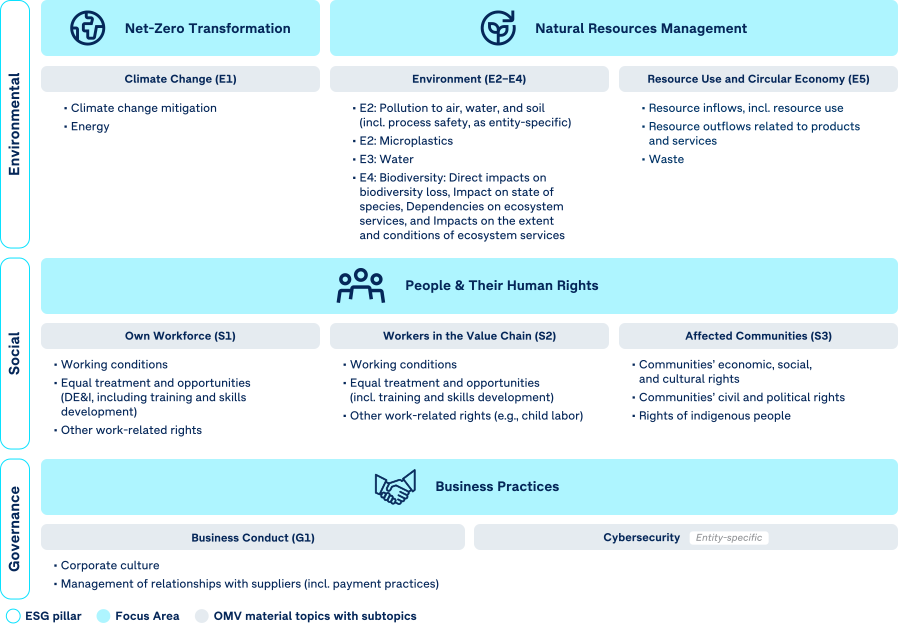
In 2024, OMV conducted a comprehensive double materiality assessment (DMA), which also serves as the fundament for the current reporting period. OMV’s review of the DMA in 2025 led to a refinement of IROs and subsequently changes to material sub-topics compared to 2024. The materiality assessment processes for 2024 and 2025 are explained in detail in IRO-1 Description of the Processes to Identify and Assess Material Impacts, Risks, and Opportunities. Climate Change Adaptation, Corruption and Bribery, Protection of Whistleblowers, and Economic Impact, along with their associated IROs, were identified as immaterial in 2025. For all IROs identified for each material topic, the ESRS disclosure requirements and NaDiVeG requirements have been addressed wherever applicable. For additional entity-specific disclosures included in this report, the “Sustainability reporting guidance for the oil and gas industry” developed by Ipieca, API, and IOGP has been taken into consideration. All additional information included that is relevant to the nature of our industry but does not stem from the aforementioned sources has been defined as a voluntary disclosure. For details, see the tables under Material Impacts, Risks, and Opportunities.
Immaterial Impacts, Risks, and Opportunities
Various considerations applied in the 2025 IRO revision led to the classification of the IROs listed below as immaterial for the current reporting year. These considerations are outlined in ESRS 2: Changes from the 2024 to 2025 Materiality Assessment. For a detailed overview of all the IROs that became immaterial in 2025, see Annex: Immaterial Impacts, Risks, and Opportunities.
Material Impacts, Risks, and Opportunities
OMV is aware of its actual and potential negative IROs related to the climate and the environment and takes these very seriously. As a consequence, OMV’s Strategy 2030 places emphasis on transforming into a sustainable, integrated energy, fuels, and chemicals company and achieving significant emissions reductions while responding to market and customer needs. In line with this strategic redirection, our business model and core business processes are continuously adapting. As in 2024, there were no identified current effects of the material IROs on the business model, value chain strategy, or decision-making in 2025, and therefore no changes were made to the Strategy and Business Model triggered by the material IROs. For details about our strategic focus and business model aligned with our sustainability targets, see SBM-1 Strategy, Business Model, and Value Chain. Concrete actions we are taking to mitigate negative environmental impacts and risks and seize opportunities are well-aligned with our strategic goals. Read more about our actions related to our material IROs in the respective chapters about Environment, Social, and Governance.
The assessment of the IROs reflects the complexity of OMV’s value chain, mapped according to the OMV operating model. The potential risk exposure of suppliers, customers, and JV partners is assessed by mapping global ESG risks and the geographies of the supply chain. This ESG risk assessment is conducted using an external global risk intelligence platform, which provides a detailed list of indices grouped as follows: climate and environment, geopolitics, and social factors, including human rights. The value chain assessment helps OMV understand its geographical concentration and identify key vulnerabilities along the supply chain, leading to the identification of adaptation measures that increase resilience to short-term challenges and megatrends. This holistic approach enables OMV to pinpoint vulnerabilities in the value chain and engage with key suppliers and customers to address potential issues. Detailed mapping of the material impacts, risks, and opportunities within the value chain can be found in the list of IROs for each topical standard. For details, see SBM-3 Material Impacts, Risks, Opportunities, and Their Interaction with Strategy and Business Model.
Material Biodiversity IROs and Their Interaction with Strategy and Business Model
Geospatial analysis revealed that several OMV sites are within or near biodiversity-sensitive areas such as national protected areas according to the Common Database on Designated Areas, Natura 2000 sites, and key biodiversity areas (KBAs). To determine material sites as well as material site-level impacts and dependencies, impacts and risks have to be analyzed at site level. OMV started to perform this analysis in the last quarter of 2023 by applying the TNFD LEAP approach to its operational sites. After working with six pilot sites in the first phase from Q3 2023 to Q3 2024, we refined the methodology, completed the Locate phase, and performed a corporate level screening of sites in 2025. We aim to complete the assessment of our operational sites (excl. filling stations) in a timely manner. Until we can disclose a full list of material sites for OMV, we have decided to provide a summary table of all sites near biodiversity-sensitive areas, independent from their actual impacts and risks. This table can be found in the chapter IRO-1 Description of the Processes to Identify and Assess Material Impacts, Risks, and Opportunities.
The activities that have the potential to negatively affect biodiversity are typical for our industry, such as exploring and developing new oil and gas resources, and producing, transporting, and refining these resources. The final use of these resources contributes to climate change, one of the drivers of biodiversity loss. New OMV activities, such as the development of geothermal resources or building plants to generate and convert circular feedstock, also have the potential to impact biodiversity, if not managed well. These activities may also lead to indirect impacts on biodiversity in both the short and long term. The effects on biodiversity can limit the availability, accessibility, or quality of natural resources, which may, in turn, negatively affect the well-being and livelihoods of local communities. The degradation of biodiversity and ecosystems is driven by terrestrial freshwater and marine ecosystem use, water and other resource use, climate change, pollution of air, soil, and water, and the potential introduction of invasive alien species, and requires our attention.
We are in the process of evaluating IROs (TNFD LEAP). For the existing sites examined so far, we have not identified any material negative impacts with regards to land degradation, desertification, or soil sealing. Based on the ongoing LEAP assessment, we have so far not identified any potential impact of our operations that would affect threatened species. We conduct our business under the assumption that our operations do not affect threatened species, however, deeper, site-level investigations will need to be performed to verify this assumption. Biodiversity impacts driven by climate change are already addressed through our Strategy 2030, which focuses on decarbonization and thereby the minimization of our contribution to climate change.
Material IROs for Our Own Workforce and Their Interaction with Strategy and Business Model
The actual and potential material impacts on our own workforce are closely linked to our business model and our strategic plans, which can only be implemented through our people. Recognizing the high safety risks of our industry, People & Culture and HSSE Strategies are crucial for successfully executing our strategy while protecting our people and complying with legal requirements. Equally, our material risk related to our own workforce stands in relation to our strategy. Building and retaining a talented and skilled team of employees for international and integrated growth is a key factor in the success of the Group’s strategy, particularly considering the strategic transformation according to our Strategy 2030 that continuously requires new knowledge. If the reskilling and training of our workforce are inefficient, this might jeopardize the successful implementation of our strategy. Therefore, we have developed a People & Culture Strategy to support our Strategy 2030 that aims to minimize negative impacts and risks and maximize positive impacts.
All our material impacts and risks related to our own workforce are thus already embedded in our Strategy and Business Model, and no major changes to these are expected. Continuous quality maintenance and improvement measures are screened and implemented as needed; however, our material impacts and risks do not currently impact our Strategy and Business Model as such. For details, see S1 Own Workforce Material Impacts, Risks, and Opportunities.
The aforementioned impacts affect all of our own employees (e.g., pipeline engineers, field technicians, chemical engineers, rig operators, financial analysts, project managers) and non-employees (e.g., leased personnel, self-employed people, or people provided by third-party undertakings primarily engaged in employment activities), which are all covered in the scope of disclosure. The negative impacts, widely identified as potential impacts, were confined to limited groups of employees such as those working under project-related pressure, and in jurisdictions where formal employee representation is legally prohibited. Isolated events related to insufficient health and safety management were identified in the reporting period (e.g., work-related injuries).
The positive impact of heightened awareness of human rights results from several actions OMV has implemented and affects the entire Group. While human rights training is mandatory for employees only, the launch of the updated Human Rights Management System and the introduction of newly appointed Human Rights Focal Persons impact the entirety of our own workforce across the organization, including employees and non-employees. Training and skills development programs aimed at both blue-collar workers and white-collar workers support satisfaction and productivity among our employees and non-employees. Special DE&I actions supporting employees that are in a minority share or are more likely to be in vulnerable situations are developed in six Employee Resource Groups (Accessibility, Gender, Generations, Intercultural, LGBTQ+, and Parenting/Caregivers).
To minimize our material risk, identified as the failure to efficiently reskill our employees in alignment with the strategic transformation needs, OMV is ensuring all employees are prepared and have the right skills for the business now and in the future. In order to facilitate a Just Transition, we need to prevent a potential shortage of skilled staff, as that could lead to reduced productivity, economic disparity, and job insecurity among employees.
Inefficient reskilling could be exacerbated by the fact that the workforce of OMV comprises more than 50% Generation X and Baby Boomer individuals. This has led to concerns as large groups are set to retire in the upcoming years. To address this risk, OMV is concentrating on improving knowledge transfer between generations and nurturing the next generation of managers through our Operational Excellence programs, thereby reducing the risk stemming from dependence on our workforce, particularly on the group of soon-to-be retirees. It is crucial that we include all employees in our upskilling strategy so that we promote fairness and inclusivity, providing equal opportunities for all employees to gain the necessary skills for existing and new roles. Aligning training programs with OMV’s strategic needs helps maintain economic stability, reducing the risk of job losses and economic hardship. Furthermore, effective training can bridge socio-economic gaps, promoting social equity and supporting sustainable growth. By addressing this risk, OMV can contribute to a Just Transition in a way that will benefit both our workforce and the broader community.
OMV’s transition plan aims to achieve climate-neutral operations by 2050, which has consequences for our Strategy and Business Model and will thus be reflected in the daily work of many of our employees. These consequences include restructuring operations and potential changes to job descriptions. Our personnel policy promotes long-term employment and continuous learning, aiming to benefit both staff and the organization through sustained working relationships. Therefore, we do not currently see nor anticipate material impacts on our workforce originating from our transition to a low-carbon business.
When it comes to particularly susceptible areas for negative impacts, OMV has operations (e.g., production of ethylene and propylene, oil and gas exploration and production, refining) in regions where weak enforcement of labor laws leads to a heightened risk of forced labor. Among these are Yemen, Pakistan, Libya, Brazil, China, and Iraq. OMV also has operations (e.g., oil and gas exploration and production, chemical-related activities) in regions where weak enforcement of labor laws leads to a heightened risk of child labor, including Yemen and Libya.
Additionally, we have identified that, due to the nature of the job, those who work in the fields in exploration, refining, and chemicals generally have a higher potential for negative impacts, especially in the event of unexpected incidents, than those who are not involved in such operations. The identification was conducted based on the results of internal consultation and assessments with P&C and human rights and HSSE experts. These potential negative impacts can be and are already being mitigated to a minimum by robust health and safety management. More details on all of the above-mentioned aspects can be found in S1 Own Workforce.
Material IROs for Workers in Our Value Chain and Their Interaction with Strategy and Business Model
When it comes to material impacts identified for workers in our value chain, namely the inadequate application of human rights principles as well as the promotion of strong human rights throughout the value chain, resulting in either poor or enhanced working conditions, a link to both OMV’s Strategy and Business Model is apparent. On the one hand, we operate our business model in an industry with a heightened risk of safety and human rights incidents. On the other hand, our Strategy 2030 emphasizes a Just Transition away from a traditional oil and gas business, with a strong focus on HSSE and human rights, not only for our own workforce but for all workers connected to our operations. Analogous to that, there is also a strong link between the material risks – potential reputational damage driven by disparities in treatment and opportunities for workers in the value chain and the reduction of expertise along the value chain – and our Strategy and Business Model. If they become manifest, both risks have the potential to jeopardize the pursuit of our transformation ambitions. Based on that, we have noticed a need to continuously develop and adjust appropriate measures within the framework of our overall strategy to manage our material impacts and risks related to workers in our value chain. However, at this stage the measures will not affect or require alteration of our Strategy and Business Model. For details, see S2 Workers in the Value Chain Material Impacts, Risks, and Opportunities.
Regarding the above-mentioned impacts and risks, all the workers in the upstream and downstream value chain are affected and are included in the scope of disclosure. In the upstream sector, this includes workers of contractors (Tier 1) and subcontractors (Tier n) performing services at OMV’s sites or on behalf of OMV, such as drilling, road, water, and air transportation, maintenance, engineering, facility management, catering, security, drivers, and consultants working from their own offices. It also includes workers of Tier 1 suppliers delivering goods and materials to OMV, such as compressors, raw materials, pipes, and engines. In the downstream sector, this includes workers who handle our products and services, even if they do not work directly on our sites. Workers identified as particularly vulnerable to negative impacts include migrant workers, people with special needs, minorities, women, young and elderly workers, workers from indigenous communities, those in hazardous roles or high-risk locations such as conflict zones and remote areas, workers with care responsibilities, and LGBTQ+ individuals.
In order to identify countries with a high risk for workers in the value chain from a human rights perspective, we use the Verisk Maplecroft global risk scoring system. Based on Verisk Maplecroft data, we consider countries with a high risk from a human rights perspective to be those countries scoring up to 5 out of 10 (on a scale of 0.00 to 10.00, where 0.00 represents the highest risk and 10.00 represents the lowest risk). Among these are Yemen, Libya, Pakistan, and China. Potential negative impacts related to the inadequate application of human rights principles are widespread and systemic and tend to occur in countries with a high risk from a human rights perspective. They are related to the insufficient monitoring of suppliers, JV partners, and other business partners, as well as the ongoing rollout and promotion of the newly established OMV grievance mechanism. Other negative impacts are related to individual incidents that can occur in relation to working conditions, including the health, safety, and well-being of workers in the value chain.
To foster the identified material positive impact of strong human rights principles, we implement various actions. These include audits, impact and risk assessments, human rights compliance checks, and contractor safety improvements. Workers performing services at OMV’s sites or on behalf of OMV could be positively affected. Furthermore, we provide training, awareness-raising, and skills development through webinars and HSSE training for all workers in the value chain working on OMV sites or where OMV has management control, and access to the TfS Academy and EcoVadis Academy platforms for workers in our upstream value chain, thus affecting them positively. Our own employees also receive awareness training on the rights of workers in the value chain through programs like mandatory human rights e-learning, which also contributes to the positive impact on workers in the value chain. Material risks arising from impacts and dependencies on value chain workers have been identified. A significant risk is the reduction in workforce expertise along the value chain linked to potential loss of skilled employees and the diminishing quality of work carried out by value chain workers if they do not benefit from strong human rights principles, including decent working conditions. Another risk involves reputational damage driven by potential disparities in treatment and opportunities for workers in the value chain.
To understand how certain workers may be at greater risk of harm, OMV has identified several risk groups based on exposure to poorly regulated or monitored labor law and standards. Migrant workers might be at greater risk of harm due to their dependency on a specific job to keep their residence permit and their greater likelihood of not having a supportive social and family network nearby. People with special needs might rely on additional conditions to ensure equal opportunities, such as barrier-free access to facilities. Minorities, women, LGBTQ+ individuals, and workers from indigenous communities might face unequal opportunities and working conditions in contexts where they are structurally or routinely discriminated against. Young and elderly workers often face heightened vulnerability due to their greater dependence on their job, either from lack of experience or limited options to find alternative employment if needed. Lone workers, lacking opportunities for professional exchange, are also more at risk of harm. Workers exposed to hazardous substances, working at height, on offshore platforms, or in other challenging environments are more prone to health and safety impacts than others. Those in conflict zones or remote areas face risks to their security and physical and mental integrity. Workers with care responsibilities are more vulnerable due to the challenge of balancing professional duties with care responsibilities, particularly in cases involving the care of the elderly, those with permanent or long-term illnesses, or when single caretakers bear the sole responsibility for their dependents. All these groups are more likely to be exposed to harm in contexts of poorly regulated or monitored labor law and standards. We apply a thorough methodology to identify negative impacts for these potentially vulnerable groups. This involves using surveys and data analysis, such as supplier risk reports and monitoring, and the internal incident reporting system. Monitoring and continuous improvement are achieved through regular assessments, including workplace audits, supplier and contractor audits, and feedback from workers in the value chain (e.g., Synergi, audits).
Our material risks arising from impacts and dependencies on value chain workers, primarily in regard to the application of human rights principles, relate to all workers in the value chain, primarily those with particular characteristics as described above. More details on all of the above-mentioned aspects can be found in S2 Workers in the Value Chain.
Material IROs for Affected Communities and Their Interaction with Strategy and Business Model
Regarding affected communities, OMV is aware that transparency, trust, and partnership-based relationships with local communities are key to ensuring that we are a responsible and welcomed neighbor wherever we operate. Therefore, there is a direct link between our identified material impacts – the failure to respect communities’ rights, the failure to create local employment, but also the creation of business opportunities and social investments – and our Strategy and Business Model. Our modus operandi and choice of business partners in locations with nearby communities may cause those impacts. To be sure to minimize and mitigate negative impacts and foster positive ones, OMV’s strategy is informed by both positive and negative impacts, which are reflected for instance in our Code of Conduct and comprehensive approach to human rights, as outlined in our Human Rights Policy Statement. The impacts inform our strategy through the measurement and fulfillment of our targets. OMV’s current strategy in this context is well suited to addressing the identified impacts with no immediate adjustments planned. For details, see S3 Affected Communities Material Impacts, Risks, and Opportunities.
Communities are defined as people living in the neighborhood of OMV’s operating sites and facilities, or more remote communities affected by OMV’s business activities. This includes various communities or individuals whose legal rights or rights under international conventions grant them legitimate claims against the organization: local communities, remote communities, and communities engaged in or affected by our value chain. Communities are exposed to impacts from OMV’s own operations and upstream value chain. Environmental impacts include soil and water pollution from process safety incidents, and social impacts include dust and noise disturbances, land use, and employment opportunities.
Local communities subject to our material impacts include those living near OMV’s operating sites and facilities, such as drilling sites, refineries, and pipeline routes, who are directly affected by our operations. Remote communities situated further from our primary sites indirectly impacted by OMV’s activities are also considered. Operating onshore and offshore, including in rural landscapes, affected communities generally include:
neighboring farmers and landowners
unskilled, semi-skilled, and skilled people living around OMV’s operations
influential community members, such as tribal, political, or religious leaders
vulnerable groups, such as migrants, minorities, women, and children, among others
indigenous tribes with connections to the land and sea within which we operate, and neighboring tribes whose areas may be negatively affected in the unlikely event of a spill. Indigenous communities are known to reside in proximity to our operations in Māui, Pohokura, and Maari in New Zealand.
These stakeholders play a crucial role in the social fabric of the communities and their perspectives are integral to our engagement processes. Our approach includes regular consultations and dialogue with these groups to understand their concerns and aspirations. This helps us to mitigate any adverse impacts and to foster positive relationships built on trust and mutual respect.
In the upstream value chain, the following communities are also subject to OMV’s identified material impacts:
remote communities (populations situated further from our primary operational sites and directly and indirectly affected by our upstream value chain activities, such as communities impacted by road transport due to construction or oil leaks on the road);
communities engaged in or affected by our value chain, including those in regions where we source raw materials and develop extraction operations, as well as areas involved in the transportation and distribution network such as communities at upstream endpoints of the value chain.
The identified potential negative material impacts on the communities in the vicinity of our operations are generally connected to individual incidents in OMV’s own operations or those from business relationships, e.g., communities’ health, safety, and quality of life, although some widespread impacts may materialize if certain procedures are not followed. Systemic impacts may be connected to problems or challenges prevalent within the local context and driven by root causes outside of OMV’s immediate control, e.g., regional employment rates, local land value. However, they nonetheless increase the risk of adverse impacts within OMV’s own operations or value chain. A key process through which we identify impacts and see if they are individual or systemic impacts is by analyzing grievances received at sites.
Due to the profile of our industry, our value chain and logistics can impact local communities negatively, for instance by causing traffic congestion and increasing air pollution levels, which may affect health and well-being. Our grievance register has previously highlighted issues related to dust and noise disturbances from our operations, which may impact the health, safety, and quality of life of local communities. These are generally individual events related to pollution incidents like spills, noise, and dust. Process Safety Management (PSM) remains a crucial focus for the Company as both a moral and business imperative. A process safety incident could significantly impact community health, safety, quality of life, and the environment, for example water contamination from drilling or exposure to hazardous substances. To mitigate these risks, effective prevention measures are implemented.
In addition to these negative impacts, positive impacts on local communities have also been identified. They include increased local employment and business development, for instance through boosted local procurement or more foot traffic for local businesses due to workers coming into an area for an OMV project. Other positive impacts are improved infrastructure and contributions to local development in the form of social and community investments such as first aid and medical care for disadvantaged communities.
OMV’s approach involves identifying and managing relationships with individuals, groups, or organizations affected by our activities or impacting our business. Stakeholder identification and analysis is a crucial part of our Community Relations & Social Investment procedures. Local community relations focal persons are responsible for identifying stakeholders, assessing their needs and potential risks and impacts related to OMV’s operations and value chain, and using this information to develop local community relations and social investments. For instance, we identified indigenous groups (iwi and hapū) in New Zealand as high-priority stakeholders due to the cultural significance of the environment and regularly engage with them through our ongoing stakeholder engagement program for OMV New Zealand. This engagement is tailored to various assets and projects, involving multiple groups to ensure their voices are heard.
No material risks and opportunities were identified for the topic of Affected Communities during the materiality assessment. However, we recognize the reputational benefits of providing ad hoc support and humanitarian aid to communities affected by natural disasters or war. More details on all of the above-mentioned aspects can be found in S3 Affected Communities.
Financial Implications of Material Risks and Opportunities
None of the material risks and opportunities identified for all E, S, and G topics had any material, measurable actual impact on OMV’s current financial position, financial performance, and cash flows. CAPEX incurred in 2025 for actions to prevent or mitigate these risks or to benefit from these opportunities is included in the tables summarizing the key actions in the respective chapters, including mapping of CAPEX to the respective impacts, risks, and opportunities. Current financial effects of material risks and opportunities for which there is a significant risk of a material adjustment to the carrying amounts of assets within the next annual reporting period, considering the base case scenario used for mid-term planning, are disclosed in the Consolidated Financial Statements Note 3 – Effects of climate change and the energy transition.
The resilience of OMV’s Strategy and Business Model helps address material impacts and risks while seizing opportunities. OMV’s strategic framework is designed to be adaptable, enabling the Company to navigate the dynamic and often volatile energy market. By integrating sustainability into its core operations, OMV takes a proactive approach to mitigating environmental risks, such as carbon emissions and resource depletion. The Company’s commitment to achieving net zero emissions by 2050 highlights its long-term vision and dedication to environmental stewardship. The significant investments in renewable energy and technological innovation positions OMV to capitalize on emerging opportunities in the sustainable energy sector. Furthermore, OMV’s risk management serves to identify and mitigate human rights and operational risks within its supply chain. In line with our Strategy 2030 and transition ambitions, OMV analyses its climate resilience. This analysis has demonstrated OMV’s ability to deliver on its Strategy 2030 and confirmed the resilience of OMV’s future portfolio with positive operating and free cash flow throughout the period from 2026 to 2040. For details, see E1: ESRS 2 SBM-3 Material Impacts, Risks, and Opportunities and Their Interaction with Strategy and Business Model.
E1 Climate Change-Related Material Impacts, Risks, and Opportunities
|
|||||||||
Sub-topics |
Description |
Further details |
Time horizon |
IRO |
–/+ |
Actual/ |
Value chain |
Relevant policies |
Type of disclosure |
|---|---|---|---|---|---|---|---|---|---|
Climate change |
|
Direct and indirect GHG emissions from operations, products, and significant energy consumption due to low energy efficiency contribute to global warming and climate change and negatively impact people and the environment. |
I |
– |
Actual |
Upstream |
Code of Conduct |
Covered by ESRS disclosure requirements and company-specific disclosures |
|
Climate change mitigation |
|
|
Long-term |
R |
|
|
Own operations |
Code of Conduct |
Covered by ESRS disclosure requirements |
Climate change mitigation |
|
|
Long-term |
O |
|
|
Own operations |
Code of Conduct |
Covered by ESRS disclosure requirements |
Energy |
|
|
Short-term, mid-term, long-term |
R |
|
|
Own operations |
Enterprise-Wide Risk Management |
Covered by ESRS disclosure requirements |
All material climate related risks mentioned in the table above are climate-related transition risks.
E2 Pollution-Related Material Impacts, Risks, and Opportunities
|
|||||||||
Sub-topics |
Description |
Further details |
Time horizon |
IRO |
–/+ |
Actual/ |
Value chain |
Relevant policies |
Type of disclosure |
|---|---|---|---|---|---|---|---|---|---|
Pollution of air |
|
The impact originates in OMV’s Strategy and Business Model, as non-GHG emissions result from OMV’s core activities. |
I |
– |
Actual and potential |
Upstream |
Code of Conduct |
Covered by ESRS disclosure requirements and company-specific disclosures |
|
Pollution of water |
Water pollution |
Pollution of water compromises water quality and negatively impacts people and the environment. |
Short-term, |
I |
– |
Potential |
Own operations |
Code of Conduct |
Covered by ESRS disclosure requirements and company-specific disclosures |
Pollution of soil, water, and |
|
|
Short-term, mid-term, long-term |
R |
|
|
Own operations |
Code of Conduct |
Covered by ESRS disclosure requirements and company-specific disclosures |
Pollution of soil, water, and |
|
Incidents during operations lead to soil, air and water pollution, which negatively impacts people and the environment. |
Short-term, mid-term, long-term |
I |
– |
Actual and potential |
Upstream |
Code of Conduct |
Covered by ESRS disclosure requirements and company-specific disclosures |
Microplastics |
|
Pollution from plastic pellet spills can negatively impact people and the environment. |
Short-term, mid-term, long-term |
I |
– |
Actual and potential |
Own operations |
Code of Conduct |
Covered by ESRS disclosure requirements |
E3 Water and Marine Resources Material Impacts, Risks, and Opportunities
|
|||||||||
Sub-topics |
Description |
Further details |
Time horizon |
IRO |
–/+ |
Actual/ |
Value chain |
Relevant policies |
Type of disclosure |
|---|---|---|---|---|---|---|---|---|---|
Water |
|
The use of water, especially from water-stressed areas negatively impacts people (availability of water) and the environment. |
I |
– |
Actual and potential |
Upstream |
Code of Conduct |
Covered by ESRS disclosure requirements and company-specific disclosures |
|
Water |
|
|
Mid-term, |
R |
|
|
Own operations |
Code of Conduct |
Covered by ESRS disclosure requirements and company-specific disclosures |
E4 Biodiversity and Ecosystems Material Impacts, Risks, and Opportunities
|
|||||||||
Sub-topics |
Description |
Further details |
Time horizon |
IRO |
–/+ |
Actual/ |
Value chain |
Relevant policies |
Type of disclosure |
|---|---|---|---|---|---|---|---|---|---|
Impacts on the extent and condition of ecosystems/ |
|
Negative impacts on biodiversity and ecosystems could affect people and the environment. |
Mid-term, |
I |
– |
Potential |
Upstream |
Code of Conduct |
Covered by ESRS disclosure requirements |
Impacts on the extent and condition of ecosystems |
|
|
Mid-term, |
R |
|
|
Own operations |
Code of Conduct |
Covered by ESRS disclosure requirements |
E5 Resource Use and Circular Economy Material Impacts, Risks, and Opportunities
|
|||||||||
Sub-topics |
Description |
Further details |
Time horizon |
IRO |
–/+ |
Actual/ |
Value chain |
Relevant policies |
Type of disclosure |
|---|---|---|---|---|---|---|---|---|---|
Resource inflows, including resource |
|
The use of sustainable instead of fossil inputs saves resources and reduces emissions, thereby positively impacting people and the environment. |
I |
+ |
Actual |
Upstream |
Code of Conduct |
Covered by ESRS disclosure requirements and company-specific disclosures |
|
Resource inflows, including resource use |
|
Increasing demand for biobased feedstock negatively impacts people and the environment. |
Mid-term, |
I |
– |
Potential |
Own operations |
Code of Conduct |
Covered by ESRS disclosure requirements |
Resource inflows, including resource use |
|
|
Mid-term, |
O |
|
|
Own operations |
Code of Conduct |
Covered by ESRS disclosure requirements |
S1 Own Workforce Material Impacts, Risks, and Opportunities
|
|||||||||
Sub-topics |
Description |
Further details |
Time horizon |
IRO |
–/+ |
Actual/ |
Value chain |
Relevant policies |
Type of disclosure |
|---|---|---|---|---|---|---|---|---|---|
Working conditions |
|
This includes disregard for freedom of association where legislation prohibits formal employee representation, and failure to address the economic and social consequences of staff release, incl. adequate wages. |
I |
– |
Potential |
Own operations |
Code of Conduct |
Covered by ESRS disclosure requirements |
|
Working conditions |
|
Project-related pressures can negatively impact workers’ health (e.g., fatigue that could lead to accidents), due to potential limited manpower that can stretch the teams to balance the demands from regulators and external partners. |
Short-term, mid-term, long-term |
I |
– |
Potential |
Own operations |
Code of Conduct |
Covered by ESRS disclosure requirements and company-specific disclosures |
Working |
|
OMV exceeds statutory obligations by providing enhanced working conditions and other work-related rights that prioritize employee well-being (for example mental health support and stress management programs). OMV actively fosters a diverse and inclusive workplace through training, by promoting equal opportunities, embracing gender equality – including equal pay for work of equal value – and ensuring the inclusion of persons with disabilities. Through proactive measures against workplace violence and harassment, OMV creates a safe, respectful, and empowering environment where all employees can thrive. |
I |
+ |
Actual and potential |
Own operations |
Code of Conduct |
Covered by ESRS disclosure requirements and company-specific disclosures |
|
Equal treatment and opportunities for all |
Inefficient reskilling and training |
|
Long-term |
R |
|
|
Own operations |
Human Resources Directive |
Covered by ESRS disclosure requirements and company-specific disclosures |
S2 Workers in the Value Chain Material Impacts, Risks, and Opportunities
|
|||||||||
Sub-topics |
Description |
Further details |
Time horizon |
IRO |
–/+ |
Actual/ |
Value chain |
Relevant policies |
Type of disclosure |
|---|---|---|---|---|---|---|---|---|---|
Working conditions/ |
|
The potential impact is connected to OMV’s strategy, as human rights violations could lead to loss of skilled workers and reputation, which are critical factors for strategy implementation. |
I |
– |
Potential |
Upstream |
Code of Conduct |
Covered by ESRS disclosure requirements and company-specific disclosures |
|
Working conditions |
|
The impact is connected to OMV’s strategy as positive working conditions support the attraction and retention of skilled value chain workers, which are critical factors for strategy implementation. |
Short-term, mid-term |
I |
+ |
Actual and potential |
Upstream |
Code of Conduct |
Covered by ESRS disclosure requirements and company-specific disclosures |
Equal treatment and opportunities for |
|
|
Short-term, mid-term |
R |
|
|
Own operation |
Code of Conduct |
Covered by ESRS disclosure requirements and company-specific disclosures |
Equal treatment and opportunities for all |
|
|
Short-term, mid-term |
R |
|
|
Own operations |
Enterprise-Wide Risk Management |
Covered by ESRS disclosure requirements |
S3 Affected Communities Material Impacts, Risks, and Opportunities
|
|||||||||
Sub-topics |
Description |
Further details |
Time horizon |
IRO |
–/+ |
Actual/ |
Value chain |
Relevant policies |
Type of disclosure |
|---|---|---|---|---|---|---|---|---|---|
Communities’ economic, social and cultural |
|
Failure to address communities’ rights, establish a respectful- and trustful relationship and find mutually acceptable solutions negatively impacts people and the environment. |
I |
– |
Actual and potential |
Upstream |
Human Rights Policy Statement |
Covered by ESRS disclosure requirements and company-specific disclosures |
|
Communities’ economic, social and cultural rights |
|
Supporting local community development leads to a respectful- and trustful relationship and positively impacts people. Through social investments, OMV contributes to the sustained improvement of living standards and the long-term resilience of local communities. The impact is connected to OMV’s strategy as trustful relationships with local communities support in creating a conducive operating environment. |
Short-term, mid-term, long-term |
I |
+ |
Actual and potential |
Upstream |
Code of Conduct |
Covered by ESRS disclosure requirements and company-specific disclosures |
Communities’ economic, social and cultural |
|
Limited employment opportunities or community development negatively impacts people. |
Mid-term, long-term |
I |
– |
Potential |
Own operations |
Code of Conduct |
Covered by ESRS disclosure requirements and company-specific disclosures |
G1 Business Conduct Material Impacts, Risks, and Opportunities
|
|||||||||
Sub-topics |
Description |
Further details |
Time horizon |
IRO |
–/+ |
Actual/ |
Value chain |
Relevant policies |
Type of disclosure |
|---|---|---|---|---|---|---|---|---|---|
Corporate culture |
|
Through its corporate culture, OMV remains a strong employer in the sector promoting a compliant and ethical corporate culture, and fostering a positive working environment and employment opportunities |
I |
+ |
Actual and potential |
Upstream |
Code of Conduct |
Covered by ESRS disclosure requirements |
|
Management of |
|
ESG supplier assessments lead to a positive impact on corporate culture in the supply chain. They can potentially lead to improvements in working |
Mid-term |
I |
+ |
Potential |
Upstream |
Corporate Procurement Directive |
Covered by ESRS disclosure requirements and company-specific disclosures |
Management of |
|
Potential negative impact due to late payments may lead to dependency and subsequent financial vulnerability of suppliers and contractors. |
Short-term, |
I |
– |
Potential |
Upstream |
Corporate Procurement Directive |
Covered by ESRS disclosure requirements and company-specific disclosures |
G-(Entity-specific): Cybersecurity Material Impacts, Risks, and Opportunities
Sub-topics |
Description |
Further details |
Time horizon |
IRO |
–/+ |
Actual/ |
Value chain |
Relevant policies |
Type of disclosure |
|---|---|---|---|---|---|---|---|---|---|
Entity specific |
|
A cyberattack may result in incorrect information about production process parameters and, in a chain reaction, could lead to physical accidents with an environmental impact such as fires, gas leaks, or oil spills. |
I |
– |
Potential |
Own operations |
IT/OT Security Directive |
Covered by company-specific disclosures |
|