
We have defined specific actions to address our material negative impact on communities resulting from the failure to respect, protect, and fulfill economic, social, civil, and cultural rights, or failure to ensure proper community consultation, compensation, and reparation, or failure to provide and enable remedy, but also to enhance our material positive impact of building respectful and trustful relations, thereby contributing to the sustained improvement of living standards and the long-term resilience of local communities. The actions are ongoing and address impacts from both our own operations and supply chain that include activities related to planning, land acquisition and exploitation, oil and gas production, use of natural resources, and other environmental and social factors. As such, these actions contribute to realizing our commitments laid out in the OMV Code of Conduct and Human Rights Policy Statement and follow the guidelines in our Sustainability Directive.
Our Community Relations & Social Investments Handbook gives further guidance for local focal persons on how to carry out these actions. Our actions are explained further in the following section and include engaging with local communities about potential and actual impacts of projects, establishing, assessing, and improving Community Grievance Mechanisms, and managing and mitigating any conflicts or grievances that arise by providing remedy, conducting community needs assessments to determine what type of community investments are necessary, and making social investments. OMV allocates substantial financial and human resources to mitigating social risks and contributing to local social, economic, and environmental advancement in the areas where we operate. This includes an annual budget to implement the actions defined in the community relations and social investment plans. We have a target to direct at least 1% of the previous year’s reported net income attributable to stockholders of the parent toward social goals. For more details, see S3-5 Targets Related to Affected Communities. Despite the resources dedicated to the actions and initiatives, none of them exceeded our key action threshold[MDR-A 69b] Key actions are defined as those requiring CAPEX of EUR ≥5 mn for their implementation through the end of the planning period. In 2025, the planning horizon was shortened from five years to three, resulting in forward-looking CAPEX that is lower compared to the Sustainability Statement 2024. CAPEX includes additions to property, plant, and equipment and to intangible assets (incl. IFRS 16 right-of-use assets) and expenditures for acquisitions, as well as equity-accounted investments and other interest for pre-defined sustainability CAPEX categories. Decommissioning assets, government grants, borrowing costs, additions to assets disposed (under certain conditions), and other additions that by definition are not considered capital expenditure are not included in CAPEX figures. Within the boundaries of applicable accounting standards, expenditure incurred during project implementation is generally capitalized, thus included in the CAPEX figures. OPEX figures related to key actions are not disclosed due to current limitations in data availability and may be included in future reports as reporting practices evolve. in the reporting year. Therefore, data requirements related to CAPEX have not been addressed.
Engagement with Communities
In the management of our community relations, engagement with affected communities is not only a means for communication and creating mutual understanding, but also an action we undertake to manage our material impacts and fulfill our strategic objectives. For our general approach to community engagement, see S3-2 Processes for Engaging with Affected Communities about Impacts. In the following section, we describe concrete engagement activities that took place in the reporting year.
In 2025, we continued our efforts to engage with communities in the vicinity of our operations about actual and potential impacts of our operations, especially impacts related to land use, planning, and construction. As an example, OMV has been engaging in cooperative partnerships in the Weinviertel region, Lower Austria, for over 60 years. In July 2023, OMV confirmed a new gas discovery at Wittau Tief-2a, with production starting in 2026. OMV developed a stakeholder engagement plan and local management held meetings with representatives of affected communities to inform them about the ongoing project. We also displayed information about our CGM on notice boards in all relevant communities. In the Styria region of Austria, we are in the process of conducting a stakeholder analysis and developing a practical engagement plan in the context of a low-carbon business project. By identifying and engaging with our stakeholders early on, we are able to avoid or mitigate actual negative impacts.
Stakeholder engagement is also central to the OMV UpHy Large project. The OMV UpHy Large project is a strategic initiative to supply the Schwechat refinery with green hydrogen. The electrolyzer is being constructed in Bruck an der Leitha and will be the fifth-largest in Europe. As a flagship facility, it will supply a significant portion of the refinery’s annual hydrogen needs, impacting various stakeholders. Here, OMV actively involves communities, government bodies, industry partners, NGOs, and environmental groups. In 2025, various stakeholders were identified and prioritized by their influence and interest, with contractors and landowners receiving special focus for pipeline installation. The Stakeholder Engagement Plan includes regular reporting and quarterly workshops to address concerns, share project updates, and discuss environmental and social impacts.
Community Grievance Mechanisms (CGMs) and Provision of Remedy
Community Grievance Mechanisms are available as a remediation measure for local communities near our operations, providing them with the opportunity to raise any concerns they may have and as the main process to identify what action is needed in response to negative impacts. For details, see S3-3 Processes to Remediate Negative Impacts and Channels for Affected Communities to Raise Concerns. OMV has set a target to assess the CGMs at all sites against the UN Effectiveness Criteria for Non-Judicial Grievance Mechanisms by 2025. As the target has been achieved, no new assessments were carried out in 2025 (see S3-5 Targets Related to Affected Communities). The CGM assessments are used to track the effectiveness of the existing processes and practices in place and identify practical improvement measures. During these assessments, internal and external stakeholders are consulted on the current performance of CGMs and on design improvements that may be necessary. We are currently implementing the follow-up actions derived from the findings to improve the CGMs. We are also exploring how to best ensure that grievance channels are available at non-operated assets; this will be a topic of increased focus in the coming years. In 2025, we continued to provide remedy for grievances raised, for instance through repairing production equipment causing loud noise, or through compensation for polluted land.
Social Investments
OMV has adopted the umbrella term “social investments” to cover any activities that involve monetary or non-monetary support and activities beyond the core business that aim to contribute to the welfare and progress of society in general. Guided by our Sustainability Directive, our social investments (including community investment projects) aim to create long-term societal value for local communities impacted by our business, thereby mitigating our potential and actual negative impact resulting from the failure to respect communities’ economic, social, and cultural rights and fostering our actual and potential positive impact of improved living standards and long-term resilience of local communities. To ensure consistency in social investments, we have set a target regarding the resources dedicated to them. For details, see S3-5 Targets Related to Affected Communities.
Community investments are aligned with identified local needs and made following consultation with local stakeholders, as well as taking into consideration country-specific priorities in relation to the Sustainable Development Goals (SDGs). We focus on projects with the potential to generate long-term societal value and make a lasting change to beneficiaries’ lives. Community and social investments are aligned with the community’s needs identified during Social and Human Rights Impact Assessments, or with broader societal priorities (e.g., by consulting the Social Progress Index).
In 2025, for example, OMV Petrom extended its support for infant health programs and continued tree planting activities in Romania. OMV Tunisia supported the first start-up acceleration program for STEM engineering graduates at the ENIG Innovation Hub – the region’s first university-based business incubator – partnering with the University of Gabes and National Engineering School of Gabes. This sustainable initiative aims to foster tech-based, innovative business solutions and promote self-employment. As digitalization is becoming more and more important to the youngest members of society, we are also offering virtual education in elementary schools in Austria. Furthermore, we delivered three state-of-the-art fire trucks in Libya to help local authorities improve the service delivery to the local communities around OMV field operations.
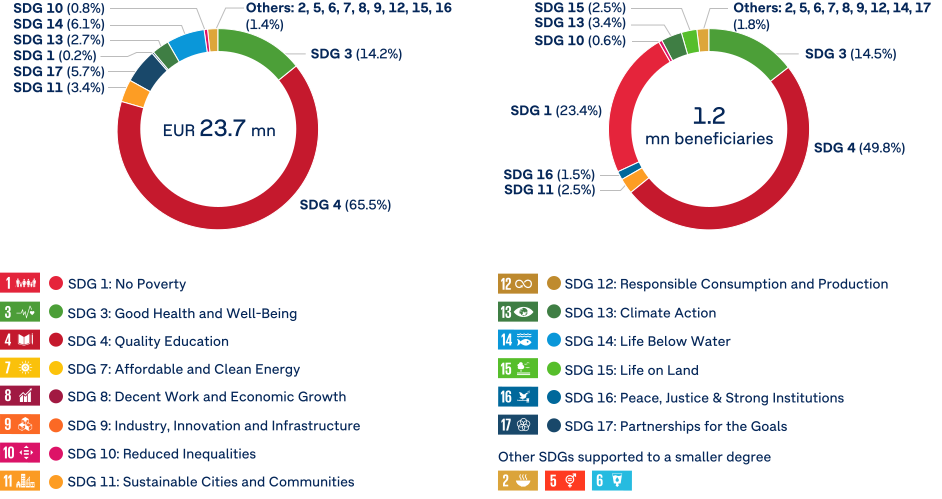
We aim to implement our projects in partnership with locally active stakeholders or non-governmental organizations to ensure a maximum social return on our investment. We see our community projects as investments, so we expect each project to generate a return for our communities, or society more broadly. These initiatives often also include knowledge transfer aimed at expanding the local technical capacity of potential workforce or value chain partners. We track the effectiveness of outcomes based on the “Input, Output, Outcome, Impact” (IOOI) methodology developed for defined social investment projects. Through tailor-made questionnaires completed by participants in projects, we gain insights and can perform a quality check of social projects. This enables us to gauge the success of our efforts to address societal challenges. Through our social investment projects, we reached 1.2 mn beneficiaries in 2025 (2024: 1.1 mn) and invested EUR 23.7 mn (2024: EUR 36.1 mn).
2025 social investments by main SDGs and number of beneficiaries
Consistent communication ensures a single strategic approach and supports OMV’s social responsibility objectives. OMV has defined three strategic social activities for our community and social investments:
Access to basic services:


Education, entrepreneurship, and employment:


Climate action and circular resource management:


In addition to the priorities defined by the Group, individual countries or subsidiaries also identify priorities that are specific to them. For instance, the Borealis Social Fund has defined three areas of social engagement that contribute to SDGs 14, 6, 7, and 4. Corporate volunteering represents another set of diverse activities carried out to deliver positive impacts for affected communities. OMV employees are encouraged to personally play an active part in sustainability initiatives, including through volunteering. We offer OMV employees the opportunity to actively engage in responsible and sustainable behavior and facilitate employee involvement with charitable partners or in combination with Company-sponsored social projects. Group-wide volunteering activities that align with specific targets are part of our community and social investments.