
About OMV
OMV is an integrated company with three pillars: Energy, Fuels, and Chemicals. In the Energy segment, OMV invests in traditional business and selectively advances renewables with the overarching goal of delivering strong and reliable cash flows. In traditional business, the focus is on gas. Gas represents a key growth engine for OMV, with anticipated longer and robust demand, playing a pivotal role in Europe’s energy landscape and acting as a key enabler of the energy transition. In 2025, hydrocarbon production reached 305 kboe/d, with around 40% gas share. OMV’s Gas Marketing & Power activities include supplying, marketing, and trading gas in Western and Eastern Europe. OMV operates natural gas storage facilities with a total capacity of around 30 TWh and a gas-fired power plant in Romania.
In the Fuels segment, OMV operates three refineries in Europe and holds a 15% share in ADNOC Refining and in ADNOC Global Trading in the UAE. OMV’s total global processing capacity amounts to around 500 kbbl/d. By the end of 2025, the retail network included around 1,700 filling stations across eight European countries. In the Chemicals segment, OMV is among the largest producers of ethylene and propylene in Europe and is one of the top ten polyolefin producers worldwide. Through its Borealis subsidiary, it also offers value-adding, innovative, and circular material solutions for key industries in its five industry clusters: Consumer Products, Energy, Health Care, Infrastructure, and Mobility. On March 3, 2025, OMV and ADNOC signed a binding agreement to combine their shareholdings in Borealis and Borouge into Borouge Group International. Post-closing, OMV will hold a 46.9% share in the new entity, with equal shareholdings and joint control alongside ADNOC. Through Borouge Group International, OMV’s production profile will shift significantly, moving from currently having 60% of production in Europe to the future Borouge Group International footprint with 70% of production in the feedstock advantaged regions of the Middle East and North America. OMV has the following head count of employees by geographical area. For details, see S1-6 Characteristics of OMV’s Employees.
Head count |
|
|
||||
|
December 31, 2025 |
December 31, 2024 |
||||
|---|---|---|---|---|---|---|
Austria |
5,356 |
5,407 |
||||
Rest of Europe |
15,675 |
16,723 |
||||
Middle East & Africa |
517 |
639 |
||||
Rest of the world |
767 |
788 |
||||
Total |
22,315 |
23,557 |
||||
|
||||||
OMV’s ambition is to transform into an integrated sustainable energy, fuels, and chemicals company, achieving net zero emissions by 2050. The Company has set interim targets for 2030 and 2040, aiming to reduce Scope 1 and 2 emissions by 30% by 2030 and 60% by 2040, and Scope 3 emissions by 20% by 2030 and 50% by 2040, all compared to 2019 levels. OMV also aims to reduce the carbon intensity of its energy supply by up to 10% by 2030 and by 25% by 2040. These reductions will be driven by increasing zero-carbon energy sales, sustainable base chemicals, and sustainable and circular products, while decreasing fossil fuel sales. OMV aims to phase out routine flaring and venting by 2030. For more information, see E1 Climate Change.
Capitalizing on the strength of its integrated business model, the OMV Strategy 2030 – introduced in 2022 – marked the beginning of OMV’s transformation journey. Driven by a focus on value creation and financial resilience, the Company has been making solid progress in execution and published the last update to the Strategy 2030 in October 2025. Looking ahead, the strategic directions remain clear and unchanged – OMV remains committed to transforming and growing into an integrated sustainable energy, fuels, and chemicals company, leading an agile transformation that aligns with customer expectations and positions OMV for long-term resilience in a rapidly changing energy landscape. This approach is increasing focus and efficiency, de-risking the transformation while ensuring strong financial performance. The energy transition continues to gain momentum, however at a slower pace than previously anticipated. As a reliable supplier, OMV continues to drive an agile and responsible transformation that is demand-led, while investing in future technologies at pace and aligning the investments in sustainable business with market developments. The Strategy 2030 is built on three pillars:
Grow gas and selectively advance renewables
Strengthen profitable fuels business while capturing opportunities in sustainable mobility
Accelerate chemical growth through Borouge Group International, feedstock integration, and driving circular innovation
In Chemicals, the formation of Borouge Group International, a landmark transaction that will accelerate OMV’s growth strategy, will significantly increase the sales volumes of innovative premium polyolefin products and position the Company at the forefront of renewable and circular economy solutions. In Fuels, OMV is targeting an annual renewable fuels and chemical feedstock production capacity of around 900 kt by 2030, focusing on SAF, biodiesel, and chemical feedstock. Key projects include co-processing, SAF/HVO, and green hydrogen plants in various OMV locations. Under the EU chemical legislation REACH, none of the substances manufactured in the three OMV refineries are subject to bans in the 27 EU and three EEA countries. As the market evolves, OMV is building a high-performance EV charging network in CEE, aiming to reach around 5,000 fast and ultra-fast charging points by 2030 and to develop a dedicated EV charging network for heavy-duty vehicles. In Energy, the Company is targeting organic oil and gas production of between 320 and 330 kboe/d by 2030, as well as looking into inorganic opportunities to complement the portfolio and reach a total production level of around 400 kboe/d by 2030. With a clear growth strategy in renewable power through its subsidiary OMV Petrom, the Company aims to achieve annual electricity output of more than 2.4 TWh (net to OMV Petrom) by capitalizing on Romania’s favorable wind and solar conditions. In geothermal energy, OMV is targeting around 1 TWh of net production output, reflecting a more measured pace of development. For more details, see E1-3 Actions and Resources Related to Climate Change Policies.
Building and retaining a talented and skilled team of employees for international and integrated growth is a key factor in the success of OMV’s strategy. Our People & Culture (P&C) Strategy fully supports the transformation of OMV. At the core of this is our purpose: “Re-inventing essentials for sustainable living.” We have developed four strategic drivers: Employee Experience, Growing Talent, Organizational Evolution, and New Ways of Working. These are all powered by a solid foundation of Transformational Leadership, driven by our leaders. To ensure that no employee is left behind in the implementation of our strategy, we are committed to a Just Transition. To facilitate this, we offer low-carbon training solutions and continue to expand our efforts to upskill our workforce. Our aim is to keep skills up to date, recognizing that existing skills can be transferred to new energy solutions. For more details, see Actions Related to Working Conditions, Equal Treatment and Opportunities, and Other Work-Related Rights.
Revenues from Fossil Fuels
The total revenue derived from fossil fuels (including a breakdown of revenue from oil and gas) and chemicals production is presented in detail in Note 7 – Sales Revenues in the Consolidated Financial Statements for year-end December 31, 2025. OMV does not generate any revenue from coal, and therefore it is not reflected in the table. In the reporting year, none of the revenue was from Taxonomy-aligned activities related to fossil gas. For details, see Taxonomy-Eligible and Taxonomy-Aligned CAPEX.
In EUR mn |
|
|
||
|
2025 |
2024 |
||
|---|---|---|---|---|
Crude oil, NGL, condensates, fuel and heating oil, other refining products |
15,432 |
16,281 |
||
Natural gas and LNG |
5,613 |
7,270 |
||
Chemical products |
588 |
696 |
||
Total |
21,633 |
24,247 |
||
|
||||
Business Model and Value Chain
OMV is an integrated sustainable energy, fuels, and chemicals company with a diverse business model that spans the entire value chain. The key components of OMV’s business model are the exploration and production of oil and natural gas and the development of low-carbon energy projects such as geothermal energy; the refining of crude oil and sustainable feedstocks into various products, including fuels, heating oil, biobased fuels, and petrochemical feedstocks; the marketing and retail business for its refined fuel products; the transportation, storage, and marketing of natural gas; the production of electricity; the production and marketing of high-quality plastics and chemicals; the mechanical and chemical recycling of plastic waste, and research and development in the field of energy, fuels and sustainable chemicals and materials. OMV’s petrochemical activities in Austria and Germany are backward integrated into its refineries. Naphtha is used as feedstock for the steam crackers operated by OMV. Key products are ethylene and propylene, which are mainly supplied to OMV’s subsidiary Borealis for further processing into polyolefins. By making use of the latest chemical and mechanical recycling technologies, OMV aims to establish a circular business model. An increasing share of the polyolefins OMV produces will thus be based on recycled feedstock. This way, OMV will continue its integrated business approach in the future.
OMV’s business model relies on a variety of inputs, which are essential for its operations across the value chain. The key inputs and OMV’s approach to gathering, developing, and securing them are:
Natural resources: Crude oil, natural gas, and other hydrocarbons obtained through exploration and production activities conducted by our own operations and purchases from global markets; biobased feedstock and plastic waste obtained from national and international markets; petrochemical products obtained from OMV’s own operations and purchased from global markets.
Technology and innovation: Advanced technologies and innovative solutions are crucial for efficient exploration, production, refining, and chemical processes. OMV invests in research and development to enhance its technological capabilities.
Human capital: Skilled and experienced employees are vital for OMV’s success. OMV focuses on attracting, developing, and retaining talent through comprehensive training programs and career development opportunities.
Financial capital: OMV requires substantial financial resources for investments in exploration, production, refining, and sustainable energy projects. OMV secures funding through a mix of equity, debt, and reinvested earnings.
Partnerships and collaborations: Strategic partnerships with other companies, research institutions, and governments are essential for accessing new resources, technologies, and markets.
OMV’s outputs and outcomes are designed to create value for a wide range of stakeholders, including customers, investors, employees, and society at large. The current and expected key benefits for the stakeholder groups are as follows:
Customers
Driving the energy transformation: OMV’s Strategy 2030 prioritizes the transformation into a sustainable, integrated energy, fuels, and chemicals company, achieving significant emissions reductions while responding to market and customer needs.
Reliable energy supply: OMV ensures a stable and secure supply of energy products, including oil, gas, petrochemicals, and sustainable energy products, which are essential for various industries and daily life.
Quality products: OMV focuses on delivering high-quality fuels and chemicals, meeting stringent environmental and safety standards.
Innovation and sustainability: OMV invests in innovative solutions such as green hydrogen and circular economy initiatives, aiming to provide more sustainable energy options for customers.
Investors
Financial performance: OMV has a strong track record of financial performance, providing returns through dividends and share price appreciation.
Strategic growth: OMV’s Strategy 2030 prioritizes growth in sustainable and innovative energy solutions, positioning the Company for long-term success.
Transparency and governance: OMV maintains high standards of corporate governance and transparency, fostering trust and confidence among investors.
Employees
Competitive compensation: OMV offers competitive wages and benefits, contributing to the economic well-being of its employees.
Career development: OMV provides opportunities for professional growth and development, including training programs and career advancement.
Safe work environment: OMV prioritizes health and safety, ensuring a safe working environment for all employees.
Just Transition: We strive to ensure that no employee is left behind in the implementation of our strategy, and we are committed to a Just Transition. Our aim is to keep skills up to date, recognizing that existing skills can be transferred to new energy solutions.
Society
Economic contribution: OMV contributes to the economy through job creation, taxes, and investments in affected communities.
Environmental stewardship: OMV is committed to reducing its environmental impact, investing in renewable energy projects, and sustainable practices.
Community engagement: OMV supports various social projects, sponsorships, and donations, enhancing the quality of life in the communities where it operates.
OMV’s integrated approach ensures that it creates value across its entire value chain, benefiting all stakeholders.
Our value chain is centered around our suppliers, contractors, assets, employees, customers, and partners. In OMV’s Fuels and Chemicals divisions and the gas sales business, our suppliers and contractors form the upstream value chain, primarily providing feedstock and components, such as crude oil, intermediates, natural gas, and LNG, as well as (petro)chemicals. These inputs are sourced from national and international energy, chemical, and trading companies. In the Energy segment, we primarily procure equipment, components, and services for our exploration, development, and drilling operations from our predominantly European supplier base, which aligns with our geographical footprint. More information on our own operations can be found in the OMV value chain illustration below and the About OMV section in this report, including a description of our business operations and further information on the geographical breakdown of our operations.
Our customers, forming the downstream value chain, range from energy companies and wholesalers to industry and end customers. Roughly half of the oil and gas produced by the Energy segment is further processed internally, with the other half mainly sold to national and international energy companies and markets. In the Fuels segment, products are primarily distributed through our retail network or industrial sales. Through our industrial sales, Fuels directly and indirectly serves end customers in the mobility segment, such as the road transport, aviation, and marine sectors, or industry customers, such as the construction industry. Additionally, Fuels provides feedstock to our Chemicals division. The Chemicals division sells base chemicals to European chemical companies, while polyolefins are sold to industry customers in more than 100 countries worldwide, primarily focusing on European markets. This division serves end users in various industries, including consumer products, energy, health care, infrastructure, and mobility. OMV’s partners along the value chain operate joint venture assets with OMV, provide feedstocks and intermediates, develop and improve technologies, and cooperate in selling our products. Moving forward, as our business model and the products offered to our customers evolve, the value chain will expand to encompass our sustainable business models.
OMV Value Chain
Click on the picture to zoom
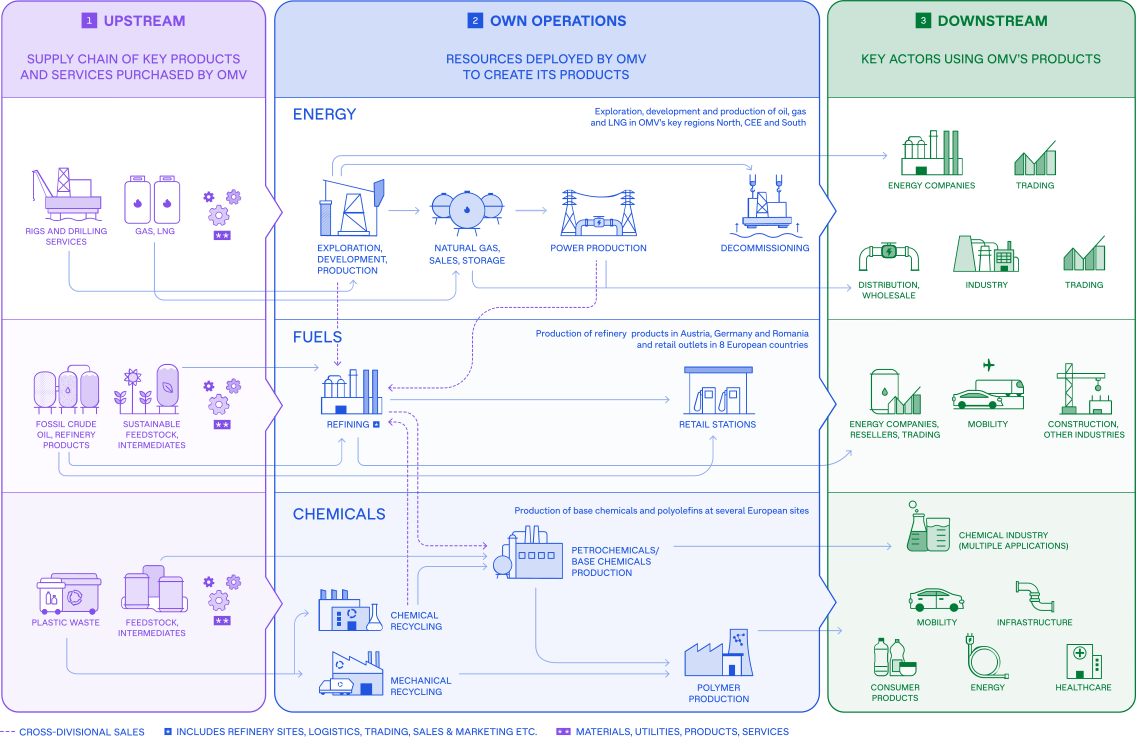
For the IROs identified during the materiality assessment related to our business model and value chain, see SBM-3 Material Impacts, Risks, and Opportunities and Their Interaction with Strategy and Business Model.