
The EU Taxonomy is a key instrument for the European Union to redirect capital flows toward sustainable investments and to create market transparency. It encourages increased channeling of investments by companies, investors, and policymakers to where they are most needed for sustainable development. Therefore, the EU Taxonomy Regulation will play an important role in scaling up sustainable investments and implementing the European Green Deal.
As part of the European Commission’s Action Plan on Financing Sustainable Growth, a classification system for environmentally sustainable economic activities was established by Regulation (EU) 2020/852 (hereinafter EU Taxonomy). The regulation came into force in 2020 and defines six environmental objectives:
Climate change mitigation
Climate change adaptation
Sustainable use and protection of water and marine resources
Transition to a circular economy
Pollution prevention and control
Protection and restoration of biodiversity and ecosystems
Since then, delegated acts on all six environmental objectives have been published. OMV recognizes the value of the EU Taxonomy regulations in promoting transparency and comparability in sustainable finance. The clear guidance provided by the Taxonomy supports the transition to a more sustainable economy and establishes a common framework for identifying sustainable investment activities. The following section outlines OMV’s approach to identifying and assessing its economic activities in accordance with the EU Taxonomy requirements.
As part of the EU Commission’s Omnibus Initiative I of 2025, Delegated Regulation (EU) 2026/73, published in the Official Journal on January 8, 2026, also amended delegated Regulation (EU) 2021/2178 to Article 8 of the EU Taxonomy Regulation (EU) 2020/852, resulting in reductions in the scope of the reporting templates and, under certain conditions, simplifications of the valuation of covered economic activities as well as financing and investments. The disclosure of the information in accordance with the EU Taxonomy Regulation (EU) 2020/852 in conjunction with (EU) 2021/2178 will take place as of December 31, 2025 in this version. Since there are still uncertainties in the legal interpretation of parts of the provisions, the legal interpretations of the EU Commission, which it has published in its notices in the Official Journal, will be used to the extent that this is deemed appropriate.
Please note that the 2024 EU Taxonomy Sales and OPEX figures have been restated following the March 2025 reclassification of the Borealis Group, excluding Borouge investments, as “held for sale” and “discontinued operations.”
OMV’s Process for Identifying and Assessing EU Taxonomy Activities
EU Taxonomy Eligibility Assessment
An economic activity is considered to be Taxonomy-eligible if it is listed in Annex I or II of the Commission Delegated Regulation (EU) 2021/2139 (EU Taxonomy Climate Delegated Act) and Annex I–IV of the Commission Delegated Regulation (EU) 2023/2486 (EU Taxonomy Environmental Delegated Act) and matches the given description of the activity.
To identify eligible activities and products at OMV, we implemented comprehensive screening of our entire portfolio, comparing our activities to the relevant activity descriptions; this process is fully integrated into our project preparation and approval procedures, involving interdisciplinary teams, multiple cross-checks, and a series of workshops and training sessions with management and experts across all business segments, ensuring that every relevant project is identified at an early stage of its life cycle.
OMV’s identified EU Taxonomy-eligible economic activities are mainly related to the environmental objective of climate change mitigation. An analysis of all our economic activities is performed on an annual basis and includes an update of the previous year’s assessment.
EU Taxonomy Alignment Assessment
According to the Taxonomy Regulation, each aligned activity must make a substantial contribution to at least one of the EU’s environmental objectives, while also ensuring that it does not significantly harm any of the other objectives and that it meets the defined minimum social safeguards.
OMV has been conducting EU Taxonomy alignment assessments since 2022 through a three-step screening process: verifying compliance with the technical screening criteria, ensuring adherence to the do no significant harm (DNSH) requirements, and meeting the minimum social safeguards. The alignment assessment is updated annually. All economic activities identified by OMV as aligned with the EU Taxonomy are related to the environmental objective of climate change mitigation.
OMV has established internal guidance that translates all EU Taxonomy requirements into clear and understandable rules for employees. This guidance also defines responsibilities for alignment checks and evidence gathering across the organization, ensuring a consistent and transparent approach.
To comply with the DNSH climate change adaptation criteria, OMV conducts comprehensive physical climate risk and vulnerability assessments in accordance with the OMV Sustainability Impact and Risk Management Standard. These assessments are carried out centrally by OMV Group Sustainability, in collaboration with Corporate Risk Management and external experts, and are regularly updated – particularly when new assets are introduced or when changes in risk exposure are identified. All analyses are fully compliant with the DNSH climate change adaptation criteria and are conducted in line with the legal requirements of the CSRD and the EU Taxonomy.
Compliance with the minimum social safeguards and governance criteria is assessed by OMV Group Sustainability, ensuring that relevant OMV policies (such as the Human Rights Policy Statement, Code of Conduct, Code of Business Ethics, Tax Strategy) are aligned with the international standards referenced in the EU Taxonomy. OMV’s human rights management system and related processes (e.g., grievance mechanisms, human rights assessments) are established in line with these international standards. The assessment confirmed that there are no gaps between the OMV Group’s approach to human rights policies and due diligence and the social safeguard requirements of the EU Taxonomy. For further details on the unadjusted gender pay gap and Board gender diversity, please refer to S1-16 Remuneration Metrics (Pay Gap and Total Remuneration) and ESRS 2 Board Diversity respectively.
Given the competition law decisions in Moldova and Ukraine against OMV’s subsidiaries, it is important to note that OMV has implemented preventive, detective, and reactive measures that aim to prevent and mitigate risks from non-compliance in the area of competition law within the organization. Preventive measures include developing binding rules to avoid compliance violations and to conduct training in this regard. In addition, advice is provided to employees on competition law topics and compliance checks are implemented in business processes. To detect misconduct, compliance violations can be reported via the whistleblowing channel and external developments are closely monitored to identify risks. Any indication of misconduct is investigated and, where appropriate, reactive measures are taken. OMV’s compliance system is regularly evaluated and has been certified according to the IDW PS 980 standard by external auditors. The last certification was conducted in 2023, whereby OMV’s compliance system was considered as best practice and suitable for identifying, controlling, and managing all significant competition law risks. For details, see G1-3 Prevention and Detection of Corruption and Bribery.
Definition of Financial KPIs
OMV’s values for the KPIs are derived from the figures reported in the Group’s consolidated IFRS financial statements. The KPIs are calculated based on the sales revenues, CAPEX, and OPEX of all fully consolidated subsidiaries of the OMV Group. Subsidiaries that are not consolidated, associated companies, and joint ventures were excluded from the calculation of KPIs as per the reporting requirements of the EU Taxonomy Regulation.
The proportion of Taxonomy-aligned economic activities in the sales revenues, CAPEX, and OPEX (the “alignment ratio”) has been calculated as the part of sales revenues, CAPEX, and OPEX derived from products and services associated with Taxonomy-aligned economic activities (numerator) divided by the total sales revenues, CAPEX, and OPEX (denominator). The same logic applies to the calculation of the “eligibility ratio.”
The denominators of the financial KPIs were defined and can be reconciled with the IFRS Consolidated Financial Statements as follows: The denominator of the turnover KPI is based on OMV’s consolidated sales revenues. For details, see Note 7 – Sales Revenues.
The denominator of the CAPEX KPI consists of additions to intangible assets (including oil and gas properties with unproved reserves), property, plant, and equipment, and IFRS 16 right-of-use assets. For further details, please refer to Note 16 – Intangible Assets and Note 17 – Property, Plant, and Equipment. Additions from business combinations are included in the denominator, except for additions to goodwill. Decommissioned assets are not included in the denominator. Furthermore, the denominator includes additions to non-current assets held for sale. Additions included in the denominator deviate from additions recognized in the IFRS Consolidated Financial Statements because government grants are not considered in the denominator, while the net presentation option is applied for the IFRS Consolidated Financial Statements.
Total OPEX consists of R&D expenses, maintenance and repair costs, other direct expenditure related to day-to-day servicing of assets, and short-term leases. R&D expenses include the research and development expenses recognized in accordance with IAS 38 and reported in the line “Other operating expenses” in the income statement. For further details, refer to Note 11 – Other Operating Expenses. Maintenance and repair costs and other direct expenditure related to day-to-day servicing of assets mainly include costs for external services, personnel expenses, and material costs related to regular and unplanned maintenance, repairs, and servicing measures. The related cost items can be found in the line items “Production and operating expenses” and “Selling, distribution, and administrative expenses” in the income statement. Expenses for short-term leases have been determined and included in line with IFRS 16. Direct costs for training and other human resources improvement needs are immaterial and therefore excluded from the denominator and the numerator.
For most of the activities, sales revenues, CAPEX, and OPEX for aligned and eligible activities could be allocated directly to individual activities listed in the Taxonomy based on data available in the Group entities’ ERP systems. This ensured that there was no double counting of aligned or eligible sales revenues, CAPEX, and OPEX. In the refineries, CAPEX for assets used for the joint production of organic basic chemicals and fuels has been allocated to the Taxonomy-eligible activity “3.14. Manufacture of organic basic chemicals.” This has also been allocated to non-eligible activities using an allocation key reflecting the yield, size, and complexity of the different refinery plants used for this purpose. The same approach was used for repair and maintenance expenses for cost centers, which are involved in the production of organic basic chemicals and fuels.
|
2025 |
|||||
|---|---|---|---|---|---|---|
|
Turnover |
CAPEX |
OPEX |
|||
|
EUR mn |
% |
EUR mn |
% |
EUR mn |
% |
|
|
|
|
|
|
|
Environmentally sustainable (Taxonomy-aligned) activities |
23 |
0.1 |
757 |
18.4 |
4 |
0.7 |
Taxonomy-eligible, but not Taxonomy-aligned activities |
1,046 |
4.3 |
686 |
16.6 |
148 |
29.5 |
Taxonomy-non-eligible activities |
23,240 |
95.6 |
2,683 |
65.0 |
349 |
69.8 |
Total |
24,308 |
|
4,125 |
|
500 |
|
|
2024 |
|||||||
|---|---|---|---|---|---|---|---|---|
|
Turnover1 |
CAPEX |
OPEX1 |
|||||
|
EUR mn |
% |
EUR mn |
% |
EUR mn |
% |
||
|
|
|
|
|
|
|
||
Environmentally sustainable (Taxonomy-aligned) activities |
17 |
0.1 |
756 |
18.7 |
2 |
0.3 |
||
Taxonomy-eligible, but not Taxonomy-aligned activities |
1,089 |
4.2 |
908 |
22.4 |
135 |
27.3 |
||
Taxonomy-non-eligible activities |
25,088 |
95.8 |
2,388 |
58.9 |
358 |
72.4 |
||
Total |
26,194 |
|
4,052 |
|
495 |
|
||
|
||||||||
Taxonomy-Eligible and Taxonomy-Aligned Turnover
In 2025, 4.3% (2024: 4.2%) of OMV’s total turnover was classified as Taxonomy-eligible (non-aligned), while 0.1% (2024: 0.1%) of OMV’s total turnover was classified as Taxonomy-aligned. In 2025, all Taxonomy-eligible/aligned turnover was related to the objective of climate change mitigation. The eligible turnover arose from activity “3.14. Manufacture of organic basic chemicals,” which reflects the activties of our Chemicals segment (e.g., production of ethylene and propylene), as well as activity “4.29. Electricity generation from fossil gaseous fuels,” mainly from power sales from the Brazi gas-fired power plant in Romania. Furthermore, the activity “4.30. High-efficiency co-generation of heat/cool and power from fossil gaseous fuels” contributed to the Taxonomy-eligible turnover.
Taxonomy-Aligned Turnover 2025
In EUR mn
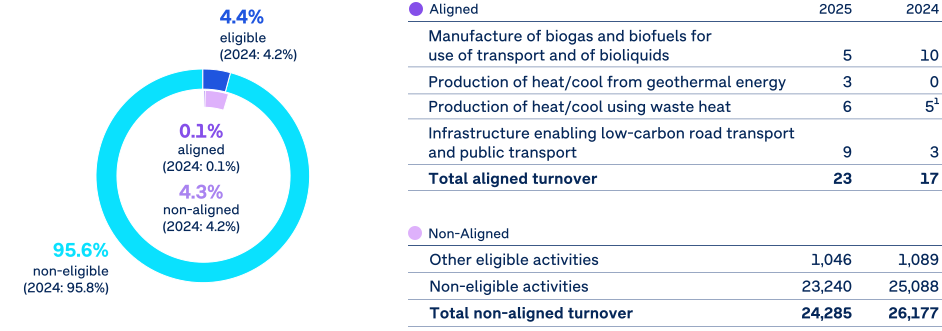
Most of the aligned turnover in 2025 was derived from the activity “6.15. Infrastructure enabling low-carbon road transport and public transport,” which covers electricity sales for mobility purposes. Further contributions to aligned turnover resulted from the activity “4.25. Production of heat/cool using waste heat,” which reflects the waste heat supplies from the Schwechat refinery, as well as the activity “4.13. Manufacture of biogas and biofuels for use in transport and of bioliquids,” which covers the sales of sustainable aviation fuels. Further aligned turnover in 2025 resulted from the activity “4.22. Production of heat/cool from geothermal energy”, representing our geothermal activities in the Vienna basin.
The split of aligned and eligible turnover between revenue from contracts with customers and revenue within the scope of IFRS 9 is included in the following table. Eligible revenue from transactions within the scope of IFRS 9 includes power sales from the gas-fired power plant in Romania.
In EUR mn |
2025 |
2024 |
||
|---|---|---|---|---|
|
Aligned |
Eligible (not aligned) turnover |
Aligned |
Eligible (not aligned) turnover |
|
|
|
|
|
Revenue from contracts with customers (IFRS 15) |
23 |
501 |
17 |
578 |
Revenue from transactions within the scope of IFRS 9 |
0 |
545 |
0 |
511 |
Total |
23 |
1,046 |
17 |
1,089 |
Taxonomy-Eligible and Taxonomy-Aligned CAPEX
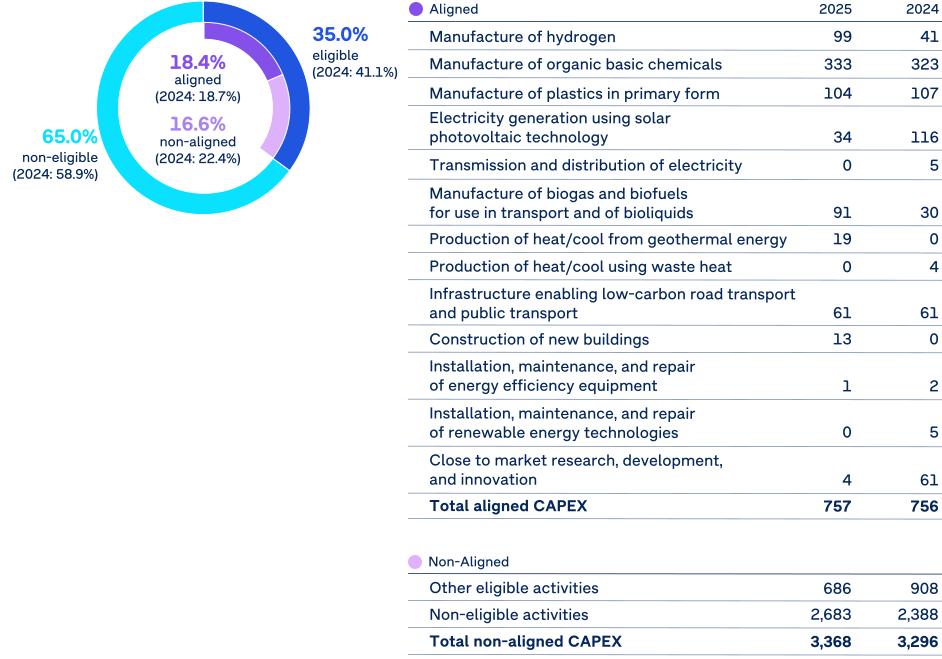
In 2025, 16.6% (2024: 22.4%) of OMV’s total CAPEX was classified as Taxonomy-eligible (non-aligned). Of OMV’s total CAPEX, 18.4% (2024: 18.7%) was classified as Taxonomy-aligned. Lower Taxonomy-eligible (non-aligned) CAPEX in 2025 compared to 2024 was related to a decrease in activity “3.14. Manufacture of organic basic chemicals.” Taxonomy-aligned CAPEX remained at a comparable level to the preceding year, as lower investments in photovoltaic technologies and close to market research were offset by substantial increases in hydrogen related expenditures, activities regarding transmission and distribution of electricity in our refineries, and geothermal initiatives.
In 2025, the majority of Taxonomy-eligible/aligned CAPEX was related to the objective of climate change mitigation, with only a minor share of eligible CAPEX being related to the environmental objective of the transition to a circular economy.
Most of the eligible CAPEX was derived from the activities “3.17. Manufacture of plastics in primary form” and “3.14. Manufacture of organic basic chemicals,” both reflecting the activities of our Chemicals segment. Other contributors were activities in Section 6 Transport (e.g., “6.2. Freight rail transport,” “6.10. Sea freight water transport,” and others), and various activities in Section 4 Energy (e.g., “4.13. Manufacture of biogas and biofuels for use in transport and of bioliquids,” “4.9. Transmission and distribution of electricity,” “4.22. Production of heat/cool from geothermal energy,” and “4.29. Electricity generation from fossil gaseous fuels”).
The largest contributors to aligned CAPEX were activities “3.14 Manufacture of organic basic chemicals,” which reflects our investment in Borealis’ propane dehydrogenation unit 2 (PDH2) in Kallo, and “3.17. Manufacture of plastics in primary form,” reflecting, for example, the investment in the pre-treatment plant in Walldürn, where we are aiming to build and operate Europe’s largest sorting facility for chemical recycling. Taxonomy-aligned CAPEX in the activity “3.10. Manufacture of hydrogen” increased significantly, driven in particular by OMV’s large-scale green hydrogen project in Austria, which aims to foster the production of Renewable Fuels of Non-Biological Origin (RFNBO) hydrogen in Europe through the construction and operation of a new, efficient, and sustainable 140 MW electrolysis plant producing up to 23,000 t of green hydrogen annually. Other important contributors to Taxonomy-aligned CAPEX were the following activities: “4.13. Manufacture of biogas and biofuels for use in transport and of bioliquids” (including production facilities for sustainable aviation fuels and bio-LNG), “6.15. Infrastructure enabling low-carbon road transport and public transport,” underscoring our continued investments in e-mobility, and “7.1. Construction of new buildings,” capturing the construction of the OMV Innovation Hub Schwechat – our new research and development facility at the OMV Schwechat site. CAPEX in the activity “4.22. Production of heat/cool from geothermal energy” more than tripled, with OMV’s “Hydros Seestadt” geothermal project in Vienna being classified as an aligned activity for the first time. The project forms part of a joint geothermal initiative aimed at harnessing high-temperature geothermal resources to provide climate-neutral district heating.
Taxonomy-Aligned CAPEX 2025
In EUR mn
Aligned and eligible CAPEX can be disaggregated into additions to the different asset classes in the table below. Additions to right-of-use assets are included in additions to property, plant, and equipment.
In EUR mn |
2025 |
2024 |
||
|---|---|---|---|---|
|
Aligned |
Eligible (not aligned) CAPEX |
Aligned |
Eligible (not aligned) CAPEX |
|
|
|
|
|
Additions to property, plant, and equipment |
725 |
658 |
690 |
883 |
Additions to capitalized development costs |
9 |
2 |
62 |
15 |
Additions to other intangible assets |
24 |
25 |
4 |
11 |
Total |
757 |
686 |
756 |
908 |
Thereof additions from business combinations |
0 |
0 |
89 |
41 |
In EUR mn |
|
|
|
|
||||
Environmental objective |
Activity |
Activity |
|
Planned CAPEX |
||||
|---|---|---|---|---|---|---|---|---|
Climate change mitigation |
3.10. |
Manufacture of hydrogen |
99 |
483 |
||||
3.14. |
Manufacture of organic basic chemicals |
333 |
0 |
|||||
3.17. |
Manufacture of plastics in primary form |
104 |
51 |
|||||
4.1. |
Electricity generation using solar photovoltaic technology |
34 |
260 |
|||||
4.3. |
Electricity generation from wind power |
0 |
64 |
|||||
4.13. |
Manufacture of biogas and biofuels for use in transport and of bioliquids |
91 |
779 |
|||||
4.22. |
Heat generation from geothermal energy |
19 |
289 |
|||||
4.25. |
Production of |
0 |
2 |
|||||
6.15. |
Infrastructure enabling low-carbon road transport and public transport |
61 |
105 |
|||||
7.1. |
Construction of new buildings |
13 |
27 |
|||||
7.3. |
Installation, maintenance, and repair of energy efficiency equipment |
1 |
2 |
|||||
9.1. |
Close to market research, development, and innovation |
4 |
16 |
|||||
Total |
|
|
757 |
2,079 |
||||
|
||||||||
Taxonomy-Eligible and Taxonomy-Aligned OPEX
In 2025, 29.5% (2024: 27.3%) of OMV’s total OPEX was classified as Taxonomy-eligible (non-aligned). Of OMV’s total OPEX, 0.7% (2024: 0.3%) was classified as Taxonomy-aligned. In 2025, all Taxonomy-eligible/aligned OPEX was related to the objective of climate change mitigation.
The largest contributor to eligible OPEX was the activity “3.14. Manufacture of organic basic chemicals,” reflecting the activities of our Chemicals segment, followed by the activities “9.1. Close to market research, development, and innovation” (e.g., R&D for ReOil®, geothermal activities, carbon capture, etc.) and “4.29. Electricity generation from fossil gaseous fuels.”
Taxonomy-Aligned OPEX 2025
In EUR mn
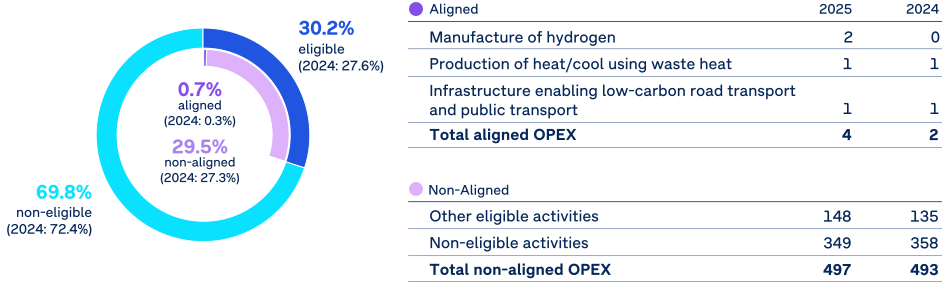
Aligned OPEX was mainly derived from the activities “3.10. Manufacture of hydrogen,” “4.25. Production of heat/cool using waste heat” (district heating hub at the Schwechat refinery), “6.15. Infrastructure enabling low- carbon road transport and public transport” (EV charging points at our filling stations), and “4.1. Electricity generation using solar photovoltaic technology.”
In EUR mn |
2025 |
2024 |
||
|---|---|---|---|---|
|
Aligned |
Eligible (not aligned) OPEX |
Aligned |
Eligible (not aligned) OPEX |
|
|
|
|
|
Research and development expenses |
0 |
59 |
0 |
44 |
Expenses for maintenance and repairs |
4 |
84 |
2 |
84 |
Short-term lease expenses |
0 |
5 |
0 |
7 |
Total |
4 |
148 |
2 |
135 |
EU Taxonomy Data Tables
EU Taxonomy – CAPEX reconciliation to Consolidated Financial Statements
In EUR mn |
|
|
|
2025 |
2024 |
|---|---|---|
Additions to intangible assets and PPE according to Consolidated Financial Statements |
3,239 |
3,697 |
Additions to intangible assets and PPE from changes in consolidated group according to Consolidated Financial Statements |
0 |
275 |
less additions to goodwill |
0 |
–106 |
plus additions to assets held for sale |
852 |
178 |
plus additions to government grants |
35 |
7 |
Total |
4,125 |
4,052 |
CAPEX according to EU Taxonomy reporting |
4,125 |
4,052 |
EU Taxonomy – Proportion of turnover, CAPEX, OPEX from products or services associated with Taxonomy-eligible or Taxonomy-aligned economic activities – disclosure covering year 2025 (summary KPIs)
Financial year |
2025 |
|
|
||||||||||||
|---|---|---|---|---|---|---|---|---|---|---|---|---|---|---|---|
|
|
|
|
|
Breakdown by environmental objectives of Taxonomy aligned activities |
|
|
|
|
|
|||||
KPI |
Total |
Proportion of Taxonomy eligible activities |
Taxonomy aligned activities |
Proportion of Taxonomy aligned activities |
Climate Change Mitigation |
Climate Change Adaptation |
Water |
Circular |
Pollution |
Biodiversity |
Proportion of enabling activities |
Proportion of transitional activities |
Not assessed activities considered non-material |
Taxonomy aligned activities in previous financial year 2024 |
Proportion of Taxonomy aligned activities in previous financial year 2024 |
(1) |
(2) |
(3) |
(4) |
(5) |
(6) |
(7) |
(8) |
(9) |
(10) |
(11) |
(12) |
(13) |
(14) |
(15) |
(16) |
|
EUR mn |
% |
EUR mn |
% |
% |
% |
% |
% |
% |
% |
% |
% |
% |
EUR mn |
% |
Turnover |
24,308 |
4.40 |
23 |
0.09 |
0.09 |
0.00 |
|
|
|
|
0.04 |
0.00 |
0.00 |
17 |
0.07 |
CAPEX |
4,125 |
34.98 |
757 |
18.36 |
18.36 |
0.00 |
|
|
|
|
1.57 |
10.58 |
0.00 |
756 |
18.66 |
OPEX |
500 |
30.16 |
4 |
0.70 |
0.70 |
0.00 |
|
|
|
|
0.20 |
0.00 |
0.00 |
2 |
0.32 |
EU Taxonomy - Proportion of turnover from products or services associated with Taxonomy-eligible or Taxonomy-aligned economic activities – disclosure covering year 2025 (activity breakdown)
Reported KPI (Turnover/CAPEX/OPEX) |
|
Turnover |
|||||||||||
|---|---|---|---|---|---|---|---|---|---|---|---|---|---|
Financial year |
|
2025 |
|||||||||||
|
|
|
|
|
Breakdown by environmental objectives of Taxonomy aligned activities |
|
|
|
|||||
Economic activities |
Code |
Taxonomy eligible KPI (Proportion of Taxonomy eligible Turnover) |
Taxonomy aligned KPI (monetary value of Turnover) |
Taxonomy aligned KPI (Proportion of Taxonomy aligned Turnover) |
Climate Change Mitigation |
Climate Change Adaptation |
Water |
Circular |
Pollution |
Biodiversity |
Enabling |
Transitional |
Proportion of Taxonomy aligned in Taxonomy eligible |
(1) |
(2) |
(3) |
(4) |
(5) |
(6) |
(7) |
(8) |
(9) |
(10) |
(11) |
(12) |
(13) |
(14) |
|
|
% |
EUR mn |
% |
% |
% |
% |
% |
% |
(E where applicable) |
|
(T where applicable) |
% |
Manufacture of organic basic chemicals |
2.05 |
0 |
0.00 |
0.00 |
|
|
|
|
|
|
|
0.00 |
|
Manufacture of biogas and biofuels for use in transport and of bioliquids |
CCM 4.13. |
0.02 |
5 |
0.02 |
0.02 |
|
|
|
|
|
|
|
100.00 |
Production of |
CCM 4.22. |
0.01 |
3 |
0.01 |
0.01 |
|
|
|
|
|
|
|
100.00 |
Production of |
CCM 4.25. |
0.02 |
6 |
0.02 |
0.02 |
|
|
|
|
|
|
|
100.00 |
Electricity generation from fossil gaseous fuels |
CCM 4.29. |
2.24 |
0 |
0.00 |
0.00 |
|
|
|
|
|
|
|
0.00 |
High-efficiency co-generation of |
CCM 4.30. |
0.00 |
0 |
0.00 |
0.00 |
|
|
|
|
|
|
|
0.00 |
Infrastructure enabling low-carbon road transport and public transport |
CCM 6.15. |
0.04 |
9 |
0.04 |
0.04 |
|
|
|
|
|
E |
|
100.00 |
Sum of alignment per objective |
|
|
|
|
0.09 |
|
|
|
|
|
|
|
|
Total KPI (Turnover) |
|
4.40 |
23 |
0.09 |
0.09 |
|
|
|
|
|
0.04 |
0.00 |
2.13 |
EU Taxonomy - Proportion of CAPEX from products or services associated with Taxonomy-eligible or Taxonomy-aligned economic activities – disclosure covering year 2025 (activity breakdown)
Reported KPI (Turnover/CAPEX/OPEX) |
|
CAPEX |
|||||||||||
|---|---|---|---|---|---|---|---|---|---|---|---|---|---|
Financial year |
|
2025 |
|||||||||||
|
|
|
|
|
Environmental objectives of Taxonomy aligned activities |
|
|
|
|||||
Economic activities |
Code |
Taxonomy eligible KPI (Proportion of Taxonomy eligible CAPEX) |
Taxonomy aligned KPI (monetary value of CAPEX) |
Taxonomy aligned KPI (Proportion of Taxonomy aligned CAPEX) |
Climate Change Mitigation |
Climate Change Adaptation |
Water |
Circular |
Pollution |
Biodiversity |
Enabling |
Transitional |
Proportion of Taxonomy aligned in Taxonomy eligible |
(1) |
(2) |
(3) |
(4) |
(5) |
(6) |
(7) |
(8) |
(9) |
(10) |
(11) |
(12) |
(13) |
(14) |
|
|
% |
EUR mn |
% |
% |
% |
% |
% |
% |
(E where applicable) |
|
(T where applicable) |
% |
Manufacture of hydrogen |
2.39 |
99 |
2.39 |
2.39 |
0.00 |
|
|
|
|
|
|
100.00 |
|
Manufacture of organic basic chemicals |
CCM 3.14., CCA 3.14. |
11.51 |
333 |
8.06 |
8.06 |
0.00 |
|
|
|
|
|
T |
70.06 |
Manufacture of plastics in primary form |
CCM 3.17., CCA 3.17. |
10.04 |
104 |
2.51 |
2.51 |
0.00 |
|
|
|
|
|
T |
25.04 |
Electricity generation using solar photovoltaic technology |
CCM 4.1., CCA 4.1. |
0.82 |
34 |
0.82 |
0.82 |
0.00 |
|
|
|
|
|
|
100.00 |
Electricity from wind power |
CCM 4.3., CCA 4.3. |
0.01 |
0 |
0.01 |
0.01 |
0.00 |
|
|
|
|
|
|
100.00 |
Transmission and distribution of electricity |
CCM 4.9., CCA 4.9. |
1.12 |
0 |
0.00 |
0.00 |
0.00 |
|
|
|
|
E |
|
0.00 |
Manufacture of biogas and biofuels for use in transport and of bioliquids |
CCM 4.13., CCA 4.13. |
2.94 |
91 |
2.20 |
2.20 |
0.00 |
|
|
|
|
|
|
74.87 |
Production of |
CCM 4.22., CCA 4.22. |
0.57 |
19 |
0.46 |
0.46 |
0.00 |
|
|
|
|
|
|
81.76 |
Electricity generation from fossil gaseous fuels |
CCM 4.29., CCA 4.29. |
0.42 |
0 |
0.00 |
0.00 |
0.00 |
|
|
|
|
|
|
0.00 |
High-efficiency co-generation of |
CCM 4.30., CCA 4.30. |
0.01 |
0 |
0.00 |
0.00 |
0.00 |
|
|
|
|
|
|
0.00 |
Renewal of water collection, treatment and supply systems |
CCM 5.2., CCA 5.2. |
0.01 |
0 |
0.00 |
0.00 |
0.00 |
|
|
|
|
|
|
0.00 |
Freight rail transport |
CCM 6.2., CCA 6.2. |
0.69 |
0 |
0.00 |
0.00 |
0.00 |
|
|
|
|
|
|
0.00 |
Transport by motorbikes, passenger cars and light commercial vehicles |
CCM 6.5., CCA 6.5. |
0.22 |
0 |
0.00 |
0.00 |
0.00 |
|
|
|
|
|
|
0.00 |
Freight transport services by road |
CCM 6.6., CCA 6.6. |
0.01 |
0 |
0.00 |
0.00 |
0.00 |
|
|
|
|
|
|
0.00 |
Sea and coastal freight water transport, vessels for port operations and auxiliary activities |
CCM 6.10., CCA 6.10. |
1.08 |
0 |
0.00 |
0.00 |
0.00 |
|
|
|
|
|
|
0.00 |
Infrastructure for rail transport |
CCM 6.14., CCA 6.14. |
0.17 |
0 |
0.00 |
0.00 |
0.00 |
|
|
|
|
|
|
0.00 |
Infrastructure enabling low-carbon road transport and public transport |
CCM 6.15. |
1.48 |
61 |
1.47 |
1.47 |
0.00 |
|
|
|
|
E |
|
99.53 |
Leasing of aircraft |
CCM 6.18. |
0.42 |
0 |
0.00 |
0.00 |
0.00 |
|
|
|
|
|
|
0.00 |
Construction of new buildings |
CCM 7.1., CCA 7.1. |
0.35 |
13 |
0.32 |
0.32 |
0.00 |
|
|
|
|
|
|
91.28 |
Renovation of existing buildings |
CCM 7.2., CCA 7.2. |
0.22 |
0 |
0.00 |
0.00 |
0.00 |
|
|
|
|
|
|
0.00 |
Installation, maintenance and repair of energy efficiency equipment |
CCM 7.3., CCA 7.3. |
0.24 |
1 |
0.02 |
0.02 |
0.00 |
|
|
|
|
E |
|
9.02 |
Installation, maintenance and repair of renewable energy technologies |
CCM 7.6., CCA 7.6. |
0.01 |
0 |
0.01 |
0.01 |
0.00 |
|
|
|
|
E |
|
69.13 |
Acquisition and ownership of buildings |
CCM 7.7., CCA 7.7. |
0.07 |
0 |
0.00 |
0.00 |
0.00 |
|
|
|
|
|
|
0.00 |
Data processing, hosting and related activities |
CCM 8.1., CCA 8.1. |
0.05 |
0 |
0.00 |
0.00 |
0.00 |
|
|
|
|
|
|
0.00 |
Close to market research, development and innovation |
CCM 9.1. |
0.09 |
4 |
0.09 |
0.09 |
0.00 |
|
|
|
|
E |
|
100.00 |
Provision of |
CE 4.1. |
0.05 |
0 |
0.00 |
0.00 |
0.00 |
|
|
|
|
|
|
0.00 |
Sum of alignment per objective |
|
|
|
|
18.36 |
0.00 |
|
|
|
|
|
|
|
Total KPI (CAPEX) |
|
34.98 |
757 |
18.36 |
18.36 |
0.00 |
|
|
|
|
1.58 |
10.58 |
52.49 |
EU Taxonomy - Proportion of OPEX from products or services associated with Taxonomy-eligible or Taxonomy-aligned economic activities – disclosure covering year 2025 (activity breakdown)
Reported KPI (Turnover/CAPEX/OPEX) |
|
OPEX |
|||||||||||
|---|---|---|---|---|---|---|---|---|---|---|---|---|---|
Financial year |
|
2025 |
|||||||||||
|
|
|
|
|
Environmental objectives of Taxonomy aligned activities |
|
|
|
|||||
Economic activities |
Code |
Taxonomy eligible KPI (Proportion of Taxonomy eligible OPEX) |
Taxonomy aligned KPI (monetary value of OPEX) |
Taxonomy aligned KPI (Proportion of Taxonomy aligned OPEX) |
Climate Change Mitigation |
Climate Change Adaptation |
Water |
Circular |
Pollution |
Biodiversity |
Enabling |
Transitional |
Proportion of Taxonomy aligned in Taxonomy eligible |
(1) |
(2) |
(3) |
(4) |
(5) |
(6) |
(7) |
(8) |
(9) |
(10) |
(11) |
(12) |
(13) |
(14) |
|
|
% |
EUR mn |
% |
% |
% |
% |
% |
% |
(E where applicable) |
|
(T where applicable) |
% |
Manufacture of hydrogen |
0.51 |
2 |
0.30 |
0.30 |
0.00 |
|
|
|
|
|
|
58.83 |
|
Manufacture of carbon black |
CCM 3.11., CCA 3.11. |
0.18 |
0 |
0.00 |
0.00 |
0.00 |
|
|
|
|
|
|
0.00 |
Manufacture of organic basic chemicals |
CCM 3.14., CCA 3.14. |
10.76 |
0 |
0.00 |
0.00 |
0.00 |
|
|
|
|
|
|
0.00 |
Electricity generation using from solar photovoltaic technology |
CCM 4.1., CCA 4.1. |
0.04 |
0 |
0.04 |
0.04 |
0.00 |
|
|
|
|
|
|
100.00 |
Transmission and distribution of electricity |
CCM 4.9., CCA 4.9. |
0.67 |
0 |
0.00 |
0.00 |
0.00 |
|
|
|
|
|
|
0.00 |
Manufacture of biogas and biofuels for use in transport and of bioliquids |
CCM 4.13., CCA 4.13. |
0.19 |
0 |
0.00 |
0.00 |
0.00 |
|
|
|
|
|
|
0.00 |
Production of |
CCM 4.22., CCA 4.22. |
0.18 |
0 |
0.00 |
0.00 |
0.00 |
|
|
|
|
|
|
0.00 |
Production of |
CCM 4.25., CCA 4.25. |
0.16 |
1 |
0.16 |
0.16 |
0.00 |
|
|
|
|
|
|
100.00 |
Electricity generation from fossil gaseous fuel |
CCM 4.29., CCA 4.29. |
3.86 |
0 |
0.00 |
0.00 |
0.00 |
|
|
|
|
|
|
0.00 |
High-efficiency co-generation of |
CCM 4.30., CCA 4.30. |
0.06 |
0 |
0.00 |
0.00 |
0.00 |
|
|
|
|
|
|
0.00 |
Underground permanent geological storage of CO2 |
CCM 5.12., CCA 5.12. |
1.45 |
0 |
0.00 |
0.00 |
0.00 |
|
|
|
|
|
|
0.00 |
Transport by motorbikes, passenger cars and light commercial vehicles |
CCM 6.5., CCA 6.5. |
0.35 |
0 |
0.00 |
0.00 |
0.00 |
|
|
|
|
|
|
0.00 |
Sea and coastal freight water transport, vessels for port operations and auxiliary activities |
CCM 6.10., CCA 6.10. |
0.62 |
0 |
0.00 |
0.00 |
0.00 |
|
|
|
|
|
|
0.00 |
Infrastructure for rail transport |
CCM 6.14., CCA 6.14. |
1.03 |
0 |
0.00 |
0.00 |
0.00 |
|
|
|
|
|
|
0.00 |
Infrastructure enabling low-carbon road transport and public transport |
CCM 6.15. |
0.20 |
1 |
0.20 |
0.20 |
0.00 |
|
|
|
|
E |
|
100.00 |
Renovation of existing buildings |
CCM 7.2., CCA 7.2. |
0.23 |
0 |
0.00 |
0.00 |
0.00 |
|
|
|
|
|
|
0.00 |
Close to market research, development and innovation |
CCM 9.1. |
9.66 |
0 |
0.00 |
0.00 |
0.00 |
|
|
|
|
|
|
0.00 |
Sum of alignment per objective |
|
|
|
|
0.70 |
0.00 |
|
|
|
|
|
|
|
Total KPI (OPEX) |
|
30.16 |
4 |
0.70 |
0.70 |
0.00 |
|
|
|
|
0.20 |
0.00 |
2.31 |